
In 1922, a big flying event was held on the Retreat Meadows, back when it was still a meadow. The World war had ended and Brattleboro was interested in the potential of aviation for civilians. Pilots flew in for a weekend of events, competitions, and demonstrations at a special aviation event that Governor Hartness, a big fan of flying, helped bring to town. Everything was going fine until late on a Friday afternoon, when disaster struck.
This is the story as it appeared in The Phoenix August 25, 1922. It isn’t hard to imagine how a tragedy such as this would perhaps sour the local citizenry on any plans of aviation or airports for quite a long time.
….
AIRPLANE MEET HAS TRAGIC END
Three Passengers Lose Lives When Curtiss Oriole Burns
Were Miss Evelyn Harris and Joseph Trahan and Son – Crowd of About 3,000 Sees Disaster – Inquiry Held.
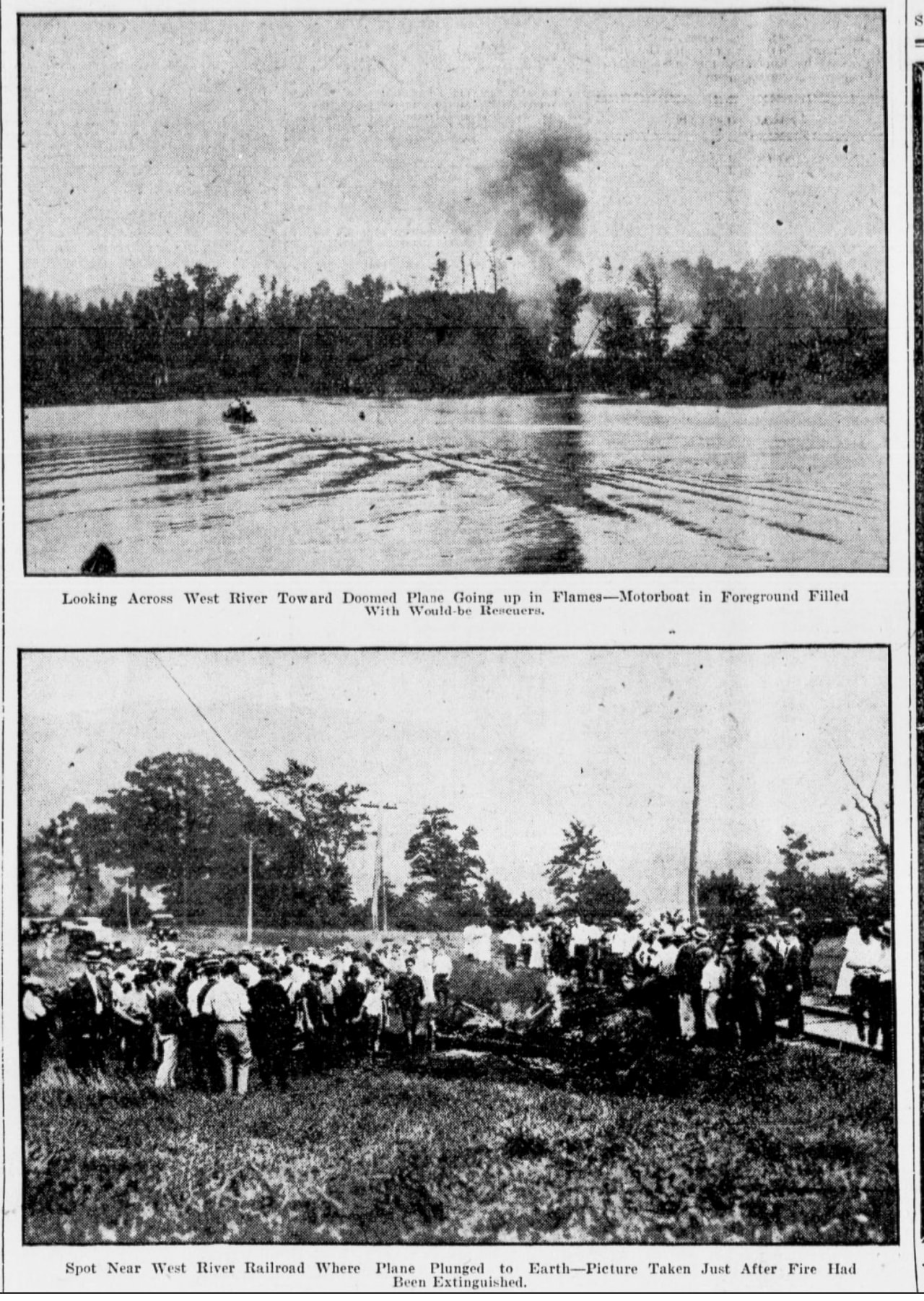
An appalling tragedy of a magnitude unknown in Brattleboro for many years and which resulted in the cessation of aerial activities at what had been up to that time one of the most successful aviation meets in New England, occurred Friday afternoon at 4:20, when one of the huge Curtiss Orioles driven by Pilot G.H. (“Jerr”) Hughes of Garden City, L.I. and carrying as passengers Miss Evelyn Harris, sister of Fred H. Harris, president of the Outing club, Joseph Trahan, proprietor of the Brooks House barber shop, and his son Norman, aged 5, crashed to the ground after striking a tree and the high tension electric wires running along the bank of the West River railroad, and instantly burst into flame burning Mr Trahan and his son to a crisp and burning Miss Harris so severely that she died at Memorial hospital about 10 Saturday morning.
The magnitude of the calamity threw a heavy pall of grief and sorrow over the community and over the county and state. The suddenness of the disaster, occurring as it did in the midst of a successful aviation event, was for a moment hardly by the nearly 3,000 persons who had gathered- on the Retreat meadows. At first a great lull fell over the throng that had witnessed the sudden fall of the plane, then the crowd, panic-stricken, surged over the wide field toward the scene of the disaster, only to be stopped by the West river, which intervened.
The tragedy happened shortly after it was announced that acrobatic stunts would be performed. Three of the planes were in the air at the time, two were at rest on the field, the ill-fated Oriole having just taken to the air, and the seventh plane, the big army DeHaviland, having already left at 3:25, with Major E.B. Lyon as pilot for its return flight Framingham, Mass.
Starts on Fatal Flight
All during the afternoon, the various planes, after finishing their part in the various events, had been giving passenger flights, some of the planes carrying passengers while taking part in the contests. The fatal plane under the direction of Pilot Hughes left the field on its last trip at exactly 4:19 with its three passengers. Five minutes later, the great ship was a mass of twisted iron and ashes.
All eyes were turned toward the Oriole as it left the field. and it was noted by many of the spectators that this was the first, and only plane that attempted to take off at the northern end of the field. Governor Hartness, who had remained to see the meet completed was heard to remark “That isn’t a good direction to go.”
The plane was seen to be laboring with difficulty as it attempted to gain its altitude under its load, but a gradual rise was effected although not sufficient to quiet the doubts in the minds of the spectators as to whether the plane would clear the trees north of the field.
When the great yellow ship had risen to a height of about 80 feet, its right wing came in contact with a tall elm tree and the suddenness of the impact caused a retardation in its speed and also served to turn the course of the plane at a right angle to the course it had pursued in leaving the field.
It was evident that Pilot Hughes endeavored to right his plane and affect a safe landing on the field adjacent to the West river railroad, but the high tension wires were in his way and a big flash of light informed the great crowd of spectators that his plane has caused a short circuit in the wires which ignited his plane, as it crashed down to its doom. In a moment flames were seen bursting from the wreckage caused by the gasoline which had exploded.
Pilot Hughes Jumps Clear
Pilot Hughes jumped clear of the machine but sustained a severe accident to his nose which later required the taking of several stitches at the Memorial hospital. Unmindful of his own injuries, he rushed to the passenger cockpit and endeavored to remove the passengers. He succeeded in assisting Miss Harris from her perilous position, but only after she had been fearfully burned about the face, hands and body, and after he himself had nearly been shocked to death by the electric current. Further attempts to assist the other passengers were impossible because of the rapidity of the spread of the flames and their intensity.
A frantic attempt to render assistance to the doomed passengers was made by Lieut. Casey Jones, pilot of a sister Oriole, who swam the West river with the hope of attainting the northern bank in time to be of assistance. The occurrence of the accident in the isolated section along the railroad made immediate succor practically impossible , especially because of the intervening river. It took several minutes for aid to reach the spot by way of Linden street down to the common and up North Main Street to the three bridges and then over the rough road across the field bordering the tracks. In a short space of time a large number of automobiles were on the spot, among them being the limousine driven by Gov. James Hartness, who had been an interested spectator all day at the meet. Governor Hartness was greatly shocked and disturbed and felt the enormity of the tragedy very keenly.
 Shortly after the Oriole crashed to the ground, Lieut. John P. Wood, pilot of “The Buffalo,” the seventh and last plane to arrive on the field at 3:15 Friday afternoon circled over the field and shouted that “everything was all right.” Charles F. Mann, who was announcing the events on the field to the assembled crowd passed on the message to the throng of spectators, who settled back in their places relieved in the belief that nothing serious had happened. When news of the disaster filtered through the crowd, everyone felt the blow all the more severely.
A distressing incident connected with the catastrophe was that the burning of the plane was witnessed by Fred H. Harris, who was a passenger in one of the three planes in the air at the time, and from his height of 2,500 feet thought it was a bonfire. When he alighted on the field and realized what had happened, he made all haste to the scene of the tragedy and worked like a demon trying to put out the flames.
Miss Harris Taken To Hospital
Miss Harris and Pilot Hughes were taken to the Memorial hospital where Pilot Hughes’s injuries were dressed, and in a short time he was able to leave for the brooks House, where he had made his headquarters.
Pilot Hughes was completely unnerved after he had been taken to the Brooks House that evening, and his mental condition was such to prevent the obtaining of a car and accurate account as to how the tragedy actually occurred. As nearly as can be learned and with he additional information secured from Pilot Casey Jones, Hughes decided to take off the field from the northern end on this particular flight because he had had difficulty in taking off from the southern end in several previous flights. Spectators will recall that on take-off just previous to the ill-fated flight, Hughes’s Oriole made a leap in the air as it struck the bump in the center of the field when landing from a previous flight, going toward the south. This particular experience caused Hughes to make the next take-off in a northerly direction.
Hughes and the other pilots were in accord with the statement that considerable “dead air” hung over the northern end of the field and the meadows north of the West river. It was this dead air or air pocket the prevented the ill-fated Oriole from attaining the altitude that Hughes expected to attain. While the pilot was attempting to gain altitude, the plane crashed hardly with any warning into the elm tree, deadening the momentum of the ship and causing it to drop among the wires which carry 10,000 volts of electric current. The impact with the heavily charged wires not only set fire to the plane but charged the wires of the plane, which hold the wings firmly together. It was these charged wires that gave Hughes his shock when he attempted to assist his passengers. Had he stumbled into the actual live wires he would have been instantly electrocuted.
The plane fell directly on its nose with its tail sticking high in the air and as soon as the flames reached the body of the ship it became a chimney of seething fire. Hughes succeeded in jumping from the ship only after he had bumped on the windshield, which gashed the right side of his nose.
Miss Harris Throws Herself Out
The position of the plane prevented immediate access to the passengers buried in the burning wreckage. They could not be reached from the rear of the machine on account of the shape of the fuselage or framework of the plane; access to the cockpit was between the wings through the heavily charged and twisted wires. Hughes saw Miss Harris throw herself out, and after managing to reach her he pulled he away from the burning wreckage and with his bare hands put out the flames which were burning her clothes. When he attempted to reach Mr Trahan and his son, Norman, the flames were so intense that he was unable to reach them.
Pilot Hughes is of the opinion that Mr. Trahan and his son were stunned by the sudden impact of the plane with the earth. Lieut. Casey said next morning that in every fatality connected with burning plane, it is always preceded by intense shrieking on the part of the person succumbing to the flames. In the tragedy Friday, not a sound emanated from the persons in the wreckage, which seems to corroborate the belief that Mr. Trahan and his son were stunned, perhaps into unconsciousness., and probably never knew that they were being burned. The pole fell across Mr. Trahan and his boy. The latter was sitting in his father’s lap.
The work of rescue was hampered further by one of the poles carrying the electric wires falling over the fuselage directly onto the cockpit where the passengers were imprisoned. The pole, which also caught fire, was removed with ropes that were secured from a truck driven by Frank Holland, who was one of the first persons to reach the spot.
George F. Stanley, Carl Herrick, and a man named Weasel, who were watching the meet from a motorboat on the West river, saw the plane as it went to its doom and they immediately hurried to the spot but were too late to rescue Mr. Trahan and his son. Their bodies at that time had already been burned beyond recognition. Miss Harris had already been rescued. They secured a rope from Mr. Holland’s ruck and succeeded in pulling the burning pole from its position.
The impact of the plane with the electric wires broke two of the wires, while the third wire swung loose from the fallen pole and remained suspended in the air. Stanley, Herrick and four or five others who had already reached the spot, attempted to put out the fire by throwing cans or dirt and water on the hot flames, but the inflammability of the material of which the wings of the plane were constructed was not in the least affected by the attempts to put out the fire. Someone brought four cans of a new fire powder, which is said to be extremely efficient in fighting flames, but the use of the powder also had no effect. Two tubes of chemicals Las were brought in an automobile, but in the excitement the tubes were dented or torn open and the chemicals leaked out on the way to the scene. Mr. Stanley and Arthur Ingalls went over to the creamery near-by and secured two more chemicals which produced no effect on the flames.
Lieut. Jones said next morning that the material of which the wings are constructed is so inflammable that once it gets on fire there is hardly any chance of it being extinguished.
Leslie C. Whitney, employed by the Windham County Co-operative Milk Producers, Inc. arrived on the spot with his Ford car and was one of the first persons to reach the scene. He took Miss Harris to the Memorial hospital, Pilot Hughes helping to hold her in the seat of the machine on the way.
Governor Visits Hospital
Fred H. Harris, after assisting to put out the flames, left for the hospital in the automobile of W.T. Carney with Pilot Jones, and he was shortly followed by the Governor’s car, containing Governor Hartness, his secretary , and a representative of The Phoenix. The Governor was greatly concerned over the tragedy and at the hospital expressed his sorrow over the misfortune. Gov. Hartness is an enthusiastic aeronaut and he flew one of the early Curtiss planes when the pilots seat was out in front where there was nothing under him but a few bamboo rods and the air. He is president of th Aeo Club of Vermont and was a big factor in arranging for the meet here. After expressing his regrets, he returned to the Brooks House, where he went to Pilot Hughes’s roman offered his sympathy. The Governor returned to his home in Springfield that evening. Pilot Hughes, after resting at the Brooks House, also left for Boston that evening.
The meet itself was a great success save for the ancient. Beginning with he dedication event in the morning, when Governor James Hartness mad etc dedication speech following the raising of Old Glory by Miss Harris, the events were staged with an alacrity that angered well for this meet being the most successful ever held in this section of the country. Three planes flew in battle formation in the morning and the event was followed by the cross country race. The bomb-dropping contest was held immediately after the lunch hour Friday afternoon and was, perhaps, the most interesting event on the program. Four planes participated in the contest, the first one being the Oriole piloted by Hughes which later went to its disaster on the field north of the West river. Each plane flew over a white target in the center of the field and from a height of 5000 feet dropped a bomb made of sand and white flour. Three trial were given each plane.
Hughes did not drop his bombs until he was well over the target and his shots went wide of the mark, one landing near the pylon, the second in the woods west of Linden street and the third in the water south of the field.
Captain H.E. Stickney made the second attempt, one of his bombs landing 27 feet away from the target. Stickney is the Vermont aviator who has a record of five German planes and one German balloon during his service with the famous Lafayette Escadrille.
Lieut. L. P. Lott was third in the event, two of his bombs landing near the pylon and landing 150 feet from the target.
Lieut. Casey Jones in the sister Oriole was fourth in the event and was the winner of the contest. $50 in prize money being awarded to him. His first shot fell near the pylon, the second 19 feet from the target, and the third 26 feet away. His average was 22 1/2 feet. He carried passengers during this event, Mrs. P Acland and Miss Ruth Bremer, both of West Dover.
Jones has been doing commercial and exhibition flying for the Curtiss company since his return from overseas where he was with the American flying forces during the World war. He has made a total of over 2,000 flying hours since he has been interest in aviation.
The planes just started acrobatic stunts when the accident to Hughes’s Oriole happened. The event was not completed and the balance of the day’s program was cancelled.
Pilot Jones said Saturday this was the first fatal accident in the records of the Curtiss company since the concern started to carry passengers. Since the war, its ships have carried over 25,000 passengers. He said Hughes made an excellent record during the war and this was his first drop as pilot. Hughes was convinced Friday night that the accident would not have happened had it not been for the high tension wires. The Oriole that met disaster Friday was the same one that broke a left forward landing strut in alighting on the field Thursday afternoon.
Seven Planes in Meet
The planes that participated in the meet Friday were seven in number and were as follows: Curtiss oriole, G.H. Hughes, pilot, flew from Mineola; Curtiss Oriole. Pilot Lieut. Casey Jones, from Mineola; JN Standard, pilot Captain H.E. Stickeny, Belows Falls; J1 Standard, Lieut. L. P. Lott, Randolph, flew from Post Mills; 400 HP DE Haviland, army plane, pilot Major E.B. Lyon, flew from Framingham; Curtiss army plane, pilot Lieut. Moffatt, flew from Framingham, and JN Standard, pilot Lieut. John B. Wood, Randolph, flew from Cambridge, N.Y.
Miss Evelyn Harris
The death of Miss Harris Saturday morning came as a great shock nd Casta cloud of sorrow over the community as well as a feeling of great sympathy. While life lingered scores of messages were received by the members of the family and friends, all inquiring the possibility of her recovery, all hoping her string vitality would carry her through the great crisis. Hopes were entertained for her recovery all through the nigh but the next morning her condition took a turn for the worse and the end came at 10 o’clock.
Miss Harris was bron in Brattleboro Jan 14, 1897, and was therefore 25 years old. She was the only daughter of Mr. And Mrs. Charles A. Harris of North street. Mr. Harris is a treasurer of the Brattleboro Savings bank. She attended the Brattleboro high school and graduated with the class of 1916. In her senior year she drew the cover for the class year book. She spent one year at Miss Porter’s school at Farmington, Conn., and the following year attended he Finch school in New York City.
She traveled extensively this country and in Europe and two years ago this summer made a camping trip on horseback through the Canadian Rockies. Last year she went on a North cape cruise to the European continent, visiting the North cape, Norway, and Sweden, the British Isles, and several of the countries on the continent. While in France she visited the devastated battlefields. While in an automobile on one of the Belgium fields one of the ties gave way just as several partially buried shells began to explode near-by, and for a time the automobile was a target for fragments of shells, but no one in the party was injured.
Miss Harris was always interested in aviation and other sports. She had taken many flights with her brother, Fred, and with other pilots. Yesterday she spent considerable time with Governor Hartness, talking over the wonderful possibilities of aviation and commenting on the wonderful success of the meet. She was also a yachting enthusiast and took great interest in boating on Lake Spofford.
…
(The story goes on to give an obit for the Trahans, discussed a visit by the Governor, tells of funerals for them, and mentions and investigation.)