
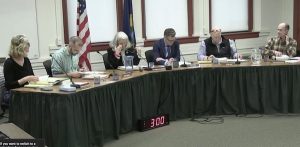
The Brattleboro Selectboard, meeting for some regular business and a discussion of the evolving FY26 budget, were able to agree on a few structural budget issues – to have a long term financial plan once again and to have a capital equipment and a capital infrastructure plans as well.
The new fire chief praised his amazing staff, and all town departments. He also gave the first accounting of what EMS services were costing the taxpayers. Solid waste and mural discussions were postponed. And the 12% tax increase was really just 6% if you average it with some other numbers.








Preliminaries
Chair Elizabeth McLoughlin starts the meeting on time!
Town Manager John Potter – can you move the mural agenda item to a future meeting.
Liz – OK. I have no remarks. Oh, wait. I have this remark about rules and regulations because they are necessary. It’s a limited public forum, raise your hand to be acknowledge, speak to the chair, first come first serve, no off topic comments, chair can protect against repetitive comments, speak twice only after everyone else and the chair says ok. No booing, clapping or cheering. Thanks to Seth to direct the new timing mechanism. For electronic participation, any zoom bombing will be immediately eliminated . Last, no party shall be permitted to make personal attacks on anyone. No one can interrogate without consent.
Potter – I’d like to thank lots of staff and organizations that helped with the fires. Fire, DPW, Tri-Park, Groundworks… thanks! The business license is currently $75 and will go up to $100. If you want to help the budget linger on your renewal. Water Quality report is now available on town website and DPW and Municipal Center.
Public –
Ivan – I’d like to thank everyone who showed up to support the constitutional order and due process… all that stuff. We all have to ask ourselves if those are things we value, and pause to answer it for yourself, then… do we expect the Brattleboro Police Department to stop ICE from kidnapping people on the streets of Brattleboro, and what are we going to do to protect ourselves from this violent gang. It’s something we have to deal with as a community, not the select board.
Bob -O – I sat the board a memo that addresses the cost data program of Medicare Collections – there is a program in effect for a couple of years, it can be done. If anyone wants it you can reach out to me.
Dick Degray – board members please lean into the mic so we can hear you. Can John give an update n the Transportation center project. There is talk that the new board members might change that project, so how far along are we and have any changes been made, and is the board interested in relocating to another location to save money on renovations?
Liz – not answering at this time. At another time. Anyone else?
Susan – I am going to keep this up every opportunity. I will bring up safety events downtown. This past Saturday morning I got a text message – someone in Harmony Lot was trying to break into different offices and stores. Saturday afternoon I was taking a break and reading a book and I saw two women lighting up a crack pipe. I saw where they got the drugs from. Police have details and photos. This stuff has to stop. Saturday afternoon at 3:30.
Consent Agenda
A. VTrans Town Highway Class II Paving Grant – Authorize Up To $200,000 Application
B. Trans Town Highway Structures Grant – Authorize Up To $200,000 Grant Application
C. Municipal Server – Authorize $22,248 Replacement Purchase
approved
Financial Quarterly Update
Potter – we don’t have the finance director so I’ll do the best I can. Bear with me. So, we have a report in the backup materials for the general fund and utilities and parking funds and some info. General Fund is 75% through and expenditures are at 83.7% (79.4). Total Revenues were at $21 million. Utilities are at 76.7% prorated. More expenses than revenues. Parking fund are at 79% (77.7). Also a loan report showing a balance of over $4 million in outstanding loans. Plus info on grants. I’ll try to answer your questions.
Isaac Evans-Frantz – I’m new and ghave some questions. can I ask about line items.
Liz – yes – I met with the town manager and asked him.
Isaac – why is the sales and meals tax are down – it looks like we got have the revenue for the fiscal year but we are 3/4 of the year.
Potter – yes – we have two payments so far and expect two more.
Amanda Ellis-Thurber – does this look relatively normal compared to other years?
Potter – we are running overbudgxt on many things on things out of our control or were unanticipated.
Liz – the purpose of this report is to show us a guide for next year’s planning but there is a recurring problem with the parking fund we are all aware of and it needs tending to in terms of the fact that … we have a procedure to use ARPA and other money, but solving that problem will be something next year.
Potter – actually, later this spring. there are parking system improvements staff would like to do, so we’ll talk about that and the budget in May. There was a planned deficit in there last year to keep the cost of parking power this year then a transition to the higher rates. I checked on our cash balance – $475k at start of fiscal year. Will you want to increase fees on parking, or ride down that deficit? One issue is the way the parking fund is structured, it relies on rentals at the Transportation center and haven’t been able to do it. Improvements might get us back on stable footing.
Amanda – which department is in charge of parking?
Potter – the police department.
Oscar Heller – this is a difficult document to summarize because some income hasn’t come yet, and some other case where we we have collected all the income, so then revenue is worse there… you just can’t take the revenue and prorate it out. Police overtime, fire overtime, and the benefits total is an expense that I would expect to be smooth, so if we have another quarter and need to spend another $1.2 million. There could be substantial deficits here. We can look more closely.
Liz – if we had a treasurer you’d have more than this printout and this analysis, or assistant town manager.
– forecasting can help with efficiencies. Software can help.
Liz – sometime s there are heads up in the reports, but generally this is a quarterly idea of where things are going – the analysis you are asking for is these inform the budget process to happen later in the year. We have software but need to use it better.
Potter – we took a snapshot a year and half ago. Some self insurance has been really high this year. That was hard to plan for. The software will allow us to plug in what each employee is anticipated to need in upcoming years. Someone is getting proficient at that. We should do better looking at costs going forward.
Dick D – the rooms and meals tax should be in this week, then the last week will be in in August. There is one more tax collection in May. How much rent will the municipality be charging for the space in the garage – you need to budget to pay rent to the enterprise fund if that goes forward. When I see the fire and police and DPW overtimes – like the year just ended we will land in a deficit. Any chance ion changing course on projects to help out now. I will ask again for month finance reports. If the select board doesn’t have questions, the public does and it is in the best interest of the town.
Liz – we’ll take it up some other time.
Oscar – if we do have another quarter of taxes to collect, I’m confused by the current tax – we budget for $17 million and collected 17 million… maybe something got transposed.
Kate – I can’t let it go. I hope you do monthly finance reports. It used to be monthly.
Liz – ok, um.
Alisa – I have a quick question. The fancy software – are all departments utilizing the software. is that what we are expecting and is that happening?
Potter – yes. All use it. The platform for our financial system.
Frans R – In my recollection, being overbudget is unusual for this time of year and it looks like it is really adding up with a risk of a deficit. I’d think you’d look at the situation an try to fix it. It is an unusual set of numbers. It cause some alarm to see this. For the rest of this year, monthly reports will be important so we can pay attention to this.
Liz – Fires – the numerous fires we had this year are a factor.
Amanda – so our software are paid for by many departments, could we learn why they all pay licensing fees?
Potter – we have many different systems in departments. Some are legacy to keep running, like assessors. There are different needs across the whole enterprise, so that’s what the costs are for.
Amanda – yes , assessor needs to be in line with the state, but the others can be with the newer financial platform. People might like to understand that.
Liz – OpenGov is shared.
David L – you may be moderating your voices – it is a struggle to hear you.
Fire Department Quarterly Update
Jay Symonds – Fire Chief and (Assistant Fire Chief Charles Keir)
Peter – do we need to vote on that? I make a motion to accept the quarterly report as presented. 5-0.
Jay – You owe me. With the board’s permission, I have an intro from me. I’ve been watching meetings since October. I know people are concerned about EMS costs. I’ll put that out for public consumption. I like to give speeches, but I wrote it down. I’m excited to be in Brattleboro, and never have been in a town where departments meet to solve problems and improve the town. We are your fire department and serve this community. Community safety involves all departments. We work with police and people to find solutions. Other agencies. We go to homes with case managers. Not 911, we take the initiative. We. are starting car seat program, for car seat installation by professionals. We are providing community education, in my 1st 7 days we had many structure fires and I saw professional responses by firefighters. All demonstrated genuine concern. We must care for town employees – if we lose them we lose knowledge. Instead of honing our skills, we have to train a new employee. There is a cost value for every employee, in finances and opportunities. I have watched several meetings and RTM, before I applied to the position. I learned it through hours of meetings. I’ve heard the terms budget crisis and dying town. We. must invest to improve, to bring in. revenue. It happens through investment. I’m proud to be here, proud of the firefighters. You truly have town departments led by professional.
Assistant Fire Chief Charles Keir – thanks. One thing I noted in previous reports we had a heavy focus on data and statistics, I got some heartfelt emails about the impact of what people are doing every day. Some are here, showing appreciation. Moving down… another fire suppression event. Out of calls noted, there was a Technical Rescue. At SIT, Capt Emery was important. This is the first time we are fully staffed for a long time. It speaks to what we are doing for recruitment and retention. We have some expected vacancies in May – Superintendent – the situation table – we made great strides. Several case management meetings attended with active community members that overly call 911 – we are helping them get services outside of 911 – and have created an electronic identification form to identify those with acute elevated risk to get them care in a more timely fashion,
Liz – the situation table is an outgrowth of the One Brattleboro committee… it is a subset where first providers make social service providers aware of repeated calls, then everyone works on solutions to help that individual person. the overall calls for emergency services are reduced.
Kier – looking at what we’ve been doing – remarkable things are happening there, and connections being built with different agencies and our town staff. EMS overview – we made progress in billing and patient care. Medicare reimbursement established and better claims payment. This is thru Marc. $484k received in payments. Since then we got 44k more. Charges of $2 million +. Contractural allowances – some is federal pay and that is the different. We may bill $1400, the state and federal government pay what they want. It is what we expect to lose. Medicare and Medicaid charges listed… some comes from VT medicare, some NH or others…. One thing was questions… missing $k…not a real good way to account for the money – we did some interfaculty transports. Each did about $1500 in reimbursements. That’s the bit you are seeing. It’s a transport from the Retreat to BMH or Cheshire Co. Or the reverse, we would handle that. Typically agencies do it. What is important is that there is a holistic approach, so if someone needs to be moved that is preventing someone from moving in, we help out in those rare occasions. We do bill for it. Some other updates – made progress with insurance reimbursements – $91k from that or so. Payer comparison shows heavy weight on medicare and medicaid. Goals – our projected reimbursement, we had start up funding, that means $587k is to meet for FY25 – we need a bit over $100k before ht year ends. Next steps, we transition to EFT payments, secondary copayment are coming in. Outstanding insurance payments – 377k. I’d say that none of our projections include self pay, we don’t include it but we do know there is a line there. We will close any gap in the coming months. Our response data. It has been a confusing mark. We got to this side by side data comparison. When we started we wanted to know how many trips, staff were used. We read a table with Golden Cross, but isn’t accurate any loner, so remove it or change it. Look at the blue section –
Liz – ours is black and white
Kier – on the right. Here is every time an ambulance arrived. Is this data you need in each report now? You want to know about when we provide a patient contact. While at SIT, we did suppression efforts then moved into a longer duration incident, so someone moved from fire to ambulance. We didn’t transport anyone. It is reflected here. I’d encourage you to ask for the yearly data mark, then decide if you want it. Patient encounters – 90 declined transport. Lists the types of calls… Fire prevention… record management system in our department is integrated for all of our activities, meet all requirements for incident reporting. Deeply intertwined. Every rental housing unit has a certificate of habitability and we track it. Inspector Nelson help at SIT to get those buildings back up for people to return to. Then, I’m most proud of a firefighter EMT get a paramedic certification. Others did a hazardous material program. We presented at conferences. WE should get new EWMT’s to start up.
Jay – the paramedic porgam is 4-8k hours of training – clinical time and classroom time. It allows them to do everything in an emergency room in the back of the ambulance. I’m a paramedic. You can’t just get through it. You have to be dedicated. The EMS numbers… I will shoot you straight. If the firefighter are terrible I’l tell you. Our EMS providers are great. These folks come with ideas to improve and get more involved. These are big deals. You have a professional staff. You really, really, do. To be clear, the cost of EMS is the difference eaten being a rescue service and a transport agency. The cost analysis that Bob sent out is different and does a percentage of calls. If we do 75% EMS calls, you take 75% of the budget for EMS. That’s not realistic. We still have the building, staff, etc. This is the difference. There are fuels, supplies, vehicles, billing, state requirements, EMS costs, – $942k to provide EMS service. That includes 7 staff members. If you quit the ambulances you wound’t want to cut all 7 firefighters. $837k is worst case for billing. $104k deficit total. We anticipate that to be smaller. That would be the minimum. There were several proposals for contracted ambulances. – we are saving $153k to provide services through the fire department. Happy to provide those numbers to the board.
Amanda – I do see on the General fund the line you said… I’d love to learn more. 68 calls for pain?
Kier – we have a large matrix of calls. So we cauterize them generally for you. That 68 could be toe stubbing…
Amanda – the PREVENT program – how is it funded and the commitment to fund it.
Kier – it is a state program that we can adapt. We have a need for the PREVENT program, and our availability with advanced EMT and paramedics, we can be a part of the program. There is a minimal cost. WE see it as an opportunity to really help somebody, and this is a great initiative to help people with addictions and to help them get to recovery sooner.
Jay – the cost is the medication cost, which is minimal.
Amanda – could the opiate settlement fund use it?
Liz – yes, but we should look for bigger fish rather than something of nominal cost.
Kier – les than $1k for the program.
Oscar – you do dangerous important work and we are approeciative. I have a question about the revenue side. This is another tricky things so I’ll use a calculator. I think the way to look at this – we have done 3/4 of a year and we have 1.6 million in billing, and if we divide that by 3, $534k a quarter x 34% collection rate… 182k per quarter… so $728k next year and we are budgeting at $881k. Getting from here to there, do we expect a change in reimbursement rates, or will billing s increase. How do we get to the budded number next year.
Jay – that’s an average number. We project we will meet the $880k this year. The math doesn’t work out perfectly. We lose out on Medicare and Medicaid. We anticipate an increased call volume. We anticipate going over those numbers… a consistent increase month to month.
Oscar – if I could see a little more math of how we got to those projections….
Liz – a review of the numerous work and the decision making about fire EMS and emergency ambulances would be helpful. Getting up to speed in that might help.
Oscar – we use the 34% number pretty liberally in our projections…
Kier – we use it liberally. It is our projected revenue. We are 9 months in and for the first time the data belongs to the town of Brattleboro and we have total access to these numbers. Previous, it was Golden Cross. The data wasn’t ours, but now it is and we are dialing in on that. At the end of the fiscal year we’lll have those numbers. Much more detailed info then…
Jay – people wanted to simplify it for easy projections. WE can invite you for a deep dive into insurance if you want.
Oscar – I want this to be a success and it is complicated so maybe I will follow up privately.
Peter case – the 34%, as we made that decision. It was a number we set as a benchmark. Sounds like we are exceeding it, so maybe we set it differently next time.
Jay – we had to teach people to fill out forms correctly so they’d accept billing.
Amanda – are you wanting for other insurance companies?
Kier – there are some small private insurers. The big ones – there are hundred and hundred we deal with. Blue Cross Blue Shield has been a priority and larger percentage drops are in there. We’ll get to the smaller carriers.
Isaac – congrats on being fully staffed. I appreciate the year to year data. One thing I notice – the average time to scene. It looks like from last year to this year you shaved off half a minute, even with a higher call volume. Consider presenting the time to science time.
Kier – we have a policy to improve keep our response time and turnout time we’re proud of. One of our biggest area of improvement – getting on the vehicle and getting there.
Liz – the reason the chart was provide – we were wrestling with how many ambulances we needed. Those decision have been made so we might shave some of this data. But response time is good.
Peter – thanks
Isaac – 90th percentile time to scene?
Kier – a national benchmark. It takes out the outliers – close and far… it gives a more accurate estimate.
Jay – we are under national standards…
Kier – we count those as fiscal years – 4 quarters.
Liz – public?
Heidi – on the chart that says EMS billing and it shows gross charges and net charges, are the ones below really part of that 1.6 million? Where are those numbers coming from (They explain). I really appreciate….. I have been asking for the expenses so I really appreciate that within one week the new chief has come up with some of the numbers. What’s the number refer to?
Jay – it is what we’ve done so far, as part of an annual cost.
Heidi – can we get the numbers to the public?
Liz – we’ll figure that out..
Randy – thanks. Going back to forecasting based on revenue margin per normal call of $14000. If you took all cals… it would be good to know our actual margin per call. It might be a larger number. Then, I hope we will do trending on paid trip volume vs non paid trips. If we need to make changes midstream we could before things go down to far. Just some suggestions..
Liz – let’s wait until the year ends and in July the numbers will be gathered and we can do some analysis. Your comments are very helpful, but good analytical benchmarks. Let’s wait til July and see where we are.
Degray – thanks Chief for those numbers. Regarding extreme overtime, how do you take that into consideration. We had huge fires in October and in our first update those overtime hours weren’t reflected , and given the firs in the last three weeks, the numbers aren’t reflected here yet. I’m concerned about how EMS impacts the overtime. I have concerns about hitting the revenue projections. And one other item.. that’s a he concern, this overtime line item, which will have an impact on us having a deficit, given this is only the third quarter. It doesn’t say here… you should have some data on it… how many calls are non-insurance for the patients we respond to. I wish that was more clearly delineated. What do you project we will expect to write off…
Liz – WE appreciate those comments but let’s wait til we get the analysis. Everyone is aware of the overtime issue. Let him work with the town manager…
Jay – we are all concerned. Everyone someone does overtime, they fill out a sheet. I have to go sheet by sheet… how many were due to structure fires. If someone takes a vacation day, we have to fill that slot. How many are for vacation, staff recalls for training… that’s the analysis we want to provide for you. I’ll do a deep dive on it.
Marta – I wanted to ask in the abstract- as a concept – I get a feeling that Randy was asking… we get a statement saying insurance only paid up to X amount.As a concept, do we bill further in that situation…
Kier – we have a stringent billing policy you can find online. Everyone is billed equally – but no obligations after a period of time if you can’t pay.
Liz – ready to move on?
they accept the report as presented.
a short break until 8 pm
is underway…
Wild Carrot Farm/Farm Stabilization
Town Assessor Jenepher Burnell – They just completed a 10 year period of farm tax stabilization. This agreement will go for one year, so we can align all of them and we can do a slate of them at one time. We have six total, and two farmers have two separate agreements due to location
Liz – more about the program?
Jenepher – it allows qualifying farmers (2/3 farm income), at least 10 acres, and agricultural products can be dairy, fruits, vegetables. Outlined in our tax stabilization procedures. You can find it online in the Assessor’s pages. You are stabilizing the house and farm land of the farmer, just the municipal tax, not the education tax.
Liz – great, thanks
Amanda – Lilac Ridge is enrolled, full disclosure. I don’t need to recuse ourselves for another farm but will for our own if that comes for a vote someday.
Dick Degray – I was wondering what the amount was? It should be in the motion.
Jenepher – $212, 150
approved!
BUDGET!
(i) Finance Committee Report / Structural Budget Issues (8:05 PM)
(ii) Solid Waste (8:35 PM)
Liz – as you know we have segmented our discussion on the budget redevelopment and tonight we’ll discuss two items, the finance committee report and solid waste.
Potter – so, for the finance committee report and structural issues, you have a copy of their report. You are asked to discuss it and mention anything you want incorporated. We also put info in a table – Attachment B – and that shows how the structure of taxes break out between town and school. It shows the had the municipal budget passed, it would have resulted in a. %6.2 inches if you incorporated the school taxes. There is also a sensitivity analysis to look at brining that down. Finally, a document was shared with a member shared to me. It is a 10 step document about a balance budget. I went down and gave an analysis as to where the town meets most of the suggestions, and where we can do things differently.
Liz – let’s ask Oscar to present the RTM Finance Committee report then we can go to the chart which is very meaningful and the 10 steps.
Oscar – a couple of main points that relate tot he structural budget questions. Some are in the 10 steps, too. And, for context, I think we should consider if there any elements of this that may not result in a line item change but we may want to try a new process, etc. I have picked out five sections in the report – the whole report is here. The first is LTFP – long term financial planning – this is my interpretation of the report and speaking for myself – I’m not tied to a specific form of LTFP but we should return to some annual planning documents – it helps us make better decisions and helps the public know what’s going on, and we can look back and hold ourselves accountable. #2 is Capital Planning – we have some but all could use a refresh. There are ways we can build out longer term capital plans that we have now. #3 is the budget process recommendations – I think most of us would like to see a longer process that starts earlier in the year with more public engagement up front. We should return to department by department budget sessions – it is more transparency and a chance for the audience to ask a question. #4 – the use of town funds – bank accounts. The use of the emergency funds. WE have guidelines. Do we want to change this? Do we need 10% Should it be changed? Worth looking ta. Then #5, the town has money sitting around – the revolving loan fund – and we should adopt some policy about how it is used. There are other things, but those are the five structural things I wanted to bring up.
Liz – we have overlapping things – the RTM report, and the 10 points Isaac brought up, and the memo of issues from John. If we start with the memo we can go topic by topic and hot them all. Let’s go that way..the first on is Long Term Financial Sustainability… what do we do now, etc.
Potter – the first was adopting. structurally balanced budget – they all are – they balance property taxes with the budget. Sometimes there is a plan for a deficit budget.
Liz – great.
Isaac – my understanding is the proposed budget for FY26 is actually not a structurally balanced budget – recurring revenues must be greater than recurring expenses, so if we are using funds from reserve that is a fixed amount. It would be helpful if we became clear on the definitions.
Potter – not correct. The budget submitted had revenues and expenditure are structural balanced. You are talking about a policy change due to the emergency last year around the police. That was incorporated, but it was balanced against the revenue
Isaac – Recurring revenue must equal recurring expenses. A balanced budget just has them equal each other.
Oscar – the emergency funding happened in FY25. The reason this is coming up is that at RTM the budget wasn’t structurally balanced. Expenses line up with revenues, but the list of cuts did include a lot of non-ongoing expenses – spending from the reserve fund, or deferring spending rather than not doing it anymore. The structurally balanced approach it to permanently reduce the costs. The current way got the numbers down but there are uses to pay off things… I really do think there are a lot of examples of that. At RTM, the refrain was about how we performed the cuts.
Potter – you were going to go through the cuts at the next meeting and review them so you can decide if you want to put them in or not.
Liz – I hope the new board doesn’t raise the budget because RTM didn’t want that.
Oscar – we want structurally balanced budgets to be our goal.
Liz – I would agree but would hold out for emergencies that would come up. Okay, item #2 – some expenses have recurring and nn recurring components.
Potter – it says it all. We try not to over estimate on sales taxes (no recurring revenue) we’ve been pretty accurate on those guesses. Also with grants, we don’t even budget for them in the general fund.
Liz – have you noticed a trend of the springtime being less revenue?
Potter – haven’t looked at it.
Liz – Identify recurring and non-recurring expenses…
Potter – So on the capital side we have been inventorying everything and getting ready for long term capital planning. We hope to get a grant and a consultant.
Liz – we hire consultants – not an employee and won’t have the costs. Just a one time service to update OpenGov so it can be used for all sorts of analysis and long term and capital planning.
Isaac – when do we hear about the grant?
Potter – we’ll find out for you
Liz – the 10% reserve – as Isaac and Oscar have talked about, we have 10% set when the town budget was $14 million. Do you increase the budget to add to the revenue, then you are taxing taxpayers to be held in place? Do we want to do that? I recall concern about we were holding space for police officers before they were actually hired. Why are taxpayers paying that amount when they weren’t hired. That money went tot he reserve fund, so now, what had been building up the reserve was salaries unspent, so we took that reserve last fall and paid for those department salaries. It’s not lost on me and an interesting tun of fate. Do we want to tax taper to build up the reserve or find other means and method to build up that reserve. How do we want tasking that cat? Staff have innovative ideas to use money that may come to the state for various purposes, but the overall stomach for taxing the public to replenish the reserve is something I’d like to hear.
Oscar – I will politely push back a little. 10% is a very common guideline, not something we invented, and it should hold us for 2 months. This is after the fact. I think nobody wants to tax the taxpayers anything. If you spend money you are always spending it. The money left the building when it was spent last year, the loss is still a cost. The cost was generated when the decision was made. I don’t want this to be – hey new board members tax the town – that’s how it felt to me.
Liz – other people might want to weigh in. We could do sources coming in from the state – we’ve been asking the legislators to increase the local option tax and there is the %5 buy down initiative. Looking to the legislature to increase our revenue and reduce the tax burden and put it into the reserve fund – we could replenish it without taxation, or a small amount in an annualized path.
Potter – that’s not going well in the legislature, but we can ask. For the current task, rebuilding the FY26 budget, a speculative revenue forecast for the state isn’t where the board will land, but you might want to express and interest in doing this. As I scramble to revise the budget…
Liz – that would involve making reduction to make account for the reserve fund amount. Do we want to talk about doing that now or specify a certain number?
Potter – or you could plan more revenues than expenditures. make it out of balance to build the reserve.
Peter – I understand generating revenue best. This fund was established in 2012 – fund balance guidelines – we didn’t have the fund before then and it hasn’t been used or needed…
Potter – the info I have says we never needed it for COVID or for the flood in 2011… that was my information.
Liz – If you”d like to address this wait until we ask for the public to speak. There is obviously a difference of opinion. I go with John Potter.
Peter – funds were only used one time. I understand the need for a rainy day fund, and know what it got used for. I have my speculations as to why people have problems with it. The plan put forward solved issues on many different levels and people felt last year was an emergency, so…
aLiz – how does the board feel about a 10% reserve? Keep it and work toward it?
Peter – recoup all in one year? (no) Plan how long it will take?
Liz – do we like 10% and then talk about all the other fund available in town government if there was an emergency, and we should talk about if we are reimbursing ourselves how much each year. We need to restructure this general fund budget. Thoughts?
Amanda – could we consider a compromise where our target level is 8% for the next 5 years then recoup to 10% at intervals over that period. A creative compromise. Or keep it at 9% and work back. The goal of 10 but maybe economic conditions won’t let us do it.
Liz – that’s interesting.
Isaac – I like that. I’d like to see a timeline to see how we get back to 10%
Amanda – strategic long term planning would be 5 years or more.
Oscar – I think it is a good idea, but we won’t get close to 8% anytime soon. if we did $100k a year it would take 14 years, and the 10% will move up as budgets increase. If we have a surplus, great. But if we run a deficit we could be set back again.
Liz – Let’s hold that thought. What are other emergency fund?
Potter – cash reserves in other funds are around $5 million sitting there? If we want 2 months of operating we have that, you could have to recoup any use of utility funds or bond funds. There is money available.
Liz – the parking fund is problematic, so we can’t count on it.
Peter – I don’t hate the idea but I hear what Oscar is saying – these conversations are fluid throughout the year and we can set a target, a goal if you will, to get there while constantly looking at what’s coming around the corner. We could get creative – cat licenses.
Potter -is there a five year goal for what yo want in the reserve?
Oscar – maybe we first decide the overall goal in an ideal world.
Liz – I like the compromise
Oscar – if our target was 8k…
Liz – the psycjolocal effect of something more achievable in as shorter period.
Amanda – it is hard to take bug gulps and easier to take small steps and be judicious . I’m not that good at it in my business. Expeditures come and you just have to deal.
Liz – the board is all entrepeneurs…
Peter – bills come due for me – sometimes I have a short window to pay… or a long window. If it is long, I’ll take little bites out of it so it is done or doesn’t hurt as much. There is no quick way. Small bites isn’t a good approach…
Amanda – there are quick ways, but not for the community.
Peter – agree
Liz – are we settled to open this to the public?
Potter – if we are at 4.5% now, do you want that bigger. I just need to know.
Liz – we do, but how much over how much time.
Oscar – the audience, then decide
Amanda – could we offset the cost of a budget item… a DPW item. ..
Liz – the utility fund is separate…
Amanda – I’d love to have a policy on shuffling things around.
Liz – John says we have enough if an emergency comes around – not shuffling – there are other sources of revenue in town.
David – I want to make it clear – the police department over several years wasn’t at the designated staff level, the unspent money went into the unassigned fund balance. It was always at 10%, not going up and up. Anything excessive was then transferred to capital, to be spent on aging infrastructure. So if you never get to the 10% level, you won’t get the excessive fund balance to use like that.
Marta – since January I’ve talked to over 100 neighbors and friends and the message I got was this year we can’t handle this tax increase, so anything to replenish the funds, having less than a 12% tax increase is the goal of me and friends. It would be more important to reduce the tax increase than to think now of replenish the funds.
Dick Degray – when legislators were there they talked about the 1% going to 75% reimbursement back tot he town. I believe that that is part of the budget process, so I would take the 5% from that and put it toward the deficit that you have in the reserve fund. the previous speaker was correct that when it went in excess, boards were using it for a number of things they were trying to do. We will have to reduce the budget somewhere else, but I believe – the fund wa established 13 years ago. It was never used for an emergency except for last year except for downtown which is up for debate. We never used it, so getting it back up to 10% could go slowly and we do have funds if there is an emergency. Take baby steps. It doesn’t matter about the percentage. Reallocate some of the 1% money. I doubt we’ll have a surplus this year. Any funding will have to come from a source other than surplus funds.
Randy – I like Amand’s idea but the end result… what will the budget be? What is the cost of living this year no one can grab on to it. I know it is less that 12% I’m guessing you’ll get to 6%. If the 1% is available from the state. It needs to be a 10, 20 year plan. Put some money toward Amandas plan. 10 years is more realistic to reach those numbers and inflation. EMS, fire, roads… calls going up. We need some increase but not 12%. Hoping for 5-6%
Mel – I think this is something we all have on our minds. But with the federal situation, we will see more flooding and less grants form a wildly unpredictable government. I don’t quite see a different between Oscar and Amanda – I don’t think there is any difference in what they were saying – get up to a big number over a period of time in a manageable way. There his agreement for the importance of the fund and even it being close to 10%
Liz – thanks for the summary and here we are. We sort of decided some things. We. agree we need a reserve budget and that it should be 8-10% and we should take baby steps and work long term to get there.
Peter – I don’t disagree but will leave it to others to figure how to do it.
Liz – we will make these policies and tell John this is what our policies is, and then he will assign mints we can live with without taxing the populace too much. The important part of this is to agree it is necessary and to work toward it, not what number we assign. That will come later.
Amanda – ideally, we can agree on the commitment and need the discipline to make it happen.
Liz – John’s chart will help us get there. We are still working through structural issues. Let’s look at #6 engage in long term financial planning…
Potter – I’m working on a projection to bring in a week or so but I need to know what you want – a long term reserve increase over 14 years, or less. If I know I can give you something.
Isaac – what Marta shared is what I have heard – 12% is too much.
Liz – that’s why we are here.
Isaac – and to have these discussion. Could we have a nominal line item so we remember that we are discussing something for FY27..
Peter – what we just talked about?
Isaac – yes – contributions to the reserve. Something tiny to start ($5k) then $100k after that, and see what that looks like.
Potter – I’d like guidance on this… for the draft budget a week from Thursday.
Amanda – clarification – the trajectory – the next meeting will be about revenue… would that allow us to make a more realistic number at next meeting?
Liz – Isaac was saying an agreement in principle to work toward the 10% and take baby steps to get there, and he suggested a nominal line item in this year’s budget. If we start with $10k, it can be altered on Thursday but gives John guidance toward the 10% reserve.
Isaac – I move we affirm a policy of maintaining a 10% reserve fund of the annual budget and have incremental spending over many years to achieve it and a nominal line item of $10k for this year in good faith.
Amanda – could we not say many but be more specific. No less than 10-15.
David – the only thing about baby steps, if the budget goes up by a million a year, $100k will not add the reserve fund . As the budget increases you are still lagging behind.
Liz – all in agreement and shall we vote?
5-0
MORE
Oscar – a proforma fy27 budget will be helpful for us, and we need to develop new long term financial planning documents. A lot on my list doesn’t need to change in this budget but I feel if we can make some general commitments as to how we do long term financial planning or a longer budget process.
Liz – we’ll get the planning grants snd Open Gov can help us after we have a consultant update it.
Oscar – I don’t want to tie us too much to the Open Gov… not too contingent on it because it is challenging and there are straightforward things we can do now.
Liz – I’m not throwing out Open Gov – we spent allot so if we put n the inputs we can get the outputs we get.
Oscar – right, but I don’t want to be hung up waiting for Open Gov if not ready. I want long range financial planning regardless in FY27.
Peter – I hear you and understand why you are saying it, and a. long term look is a good idea, bit one thing we do is he budget, but there are many other things we need to do. Lengthening the budget process is… you increase the budget by doing that.
Liz – the work of the town is more than the budget. The needs of the town are the decisions that create the budget. The elephant in the room is the community safety emergency is what prompted the need for the BRAT team and ONE Brattleboro. That was the work of the selectbaodrd and town and it had an impact on the budget. Is the tail wagging the dog. The work of the town was to fix the problem, and it has budget implications, but our responsibility is to the needs of the community..
Amanda – you are nothing right but I want tobacco up Oscar. Long term projections can help us. OpenGov is working well, on a good roll. Let;s keep it rolling, and consider there is other stud we need to get done and it might not be as painful as we think.
Liz – we can walk and chew gum. If we use the software we have to do the long term planning and let it o the work that has been promised – you want Open Gov and a narrative.
Oscar – my cancer is that last year when people ran the bell about long term planning we were told Open Gov wasn’t ready, and don’t want that again.
Liz – any open items on theist?
Potter – you touched on lots of them. Communicating with stakeholders, regular reporting…
Liz – we should work on the budget. We have made some structural long term planning reserves.. but to ask for monthly reports in a month we are restructuring the budget is excessive.
Oscar – I could see not doing it next month. The numbers we saw today… one more before the fiscal years ends at least.
Potter – we have been providing month reports, just not verbally at the meetings.
Isaac – we want to understand our agreement around long term financial planning – I move we do 5 year plans and a 25 year capital equipment plan for FY27, do it in FY26. We are down some staff… we can give ourselves a few months before we start on that, and ideally we can use OpenGov for that.
David – the 25 year capital equipment replacement plan is fine. That’s along horizon. You need a five year capital infrastructure plan, not just general fund. To talk about the pool, DPW facility… that needs to be articulated in a planned way as well.
Amanda – those are good ideas to help with for grant funding, too.
Oscar – there is general openness to lots of these topics and trying new things. I hope we’ll all be in a similar frame of mind next fall. One thing I wanted to specifically ask about. I think we would have to go in with a machete to get this budget to 5-6%. I’d prefer to commit to a goal of a target of 3 or 4% goal. It takes weight off of things being a deferral. If we do it for the next budget we can make fewer changes now.
Liz – not sure we’ve ever done that. There are guidelines and hope to be in a certain range. At the next discussion, this chart he put together…
Isaac – I’d like to incorporate the 5 year capital infrastructure plan idea. (reads motion again)
Liz – it is too confusing to say we are working in the FY26, you are planning the FY27 budget.
Isaac – that would be the first year.
Liz – please use the FY27 so we don’t lose our minds.
Isaac – reads motion again. It’s not the FY27 budget to plan.
Liz – I still want to use the convention to talk about planning the FY27 budget you use FY27 as the starting date. How would you phrase this…
Peter – just change FY26 to FY27.
Isaac – we aren’t doing the planning in FY27.
they work it out.
5-0
Liz – I’d like John to explain his chart… the fy26 ramifications and restructuring
More
Potter – this shows the combined effects of municipal and school taxes on the property tax bill you will get in the mail. It shows what happened before and what happened this year – total amount collected was 19.8 million for municipal and 22 million for schools for property tax bill of $41 million – 6.2.% increase over FY25. School tax will be considerably lower so the impact of the lower school tax is significant. Look at the out columns – you could bring it down further if you reduce $100k you get property tax down to 5.9%, and if you cut $250k it is a 5.5% increase… and 500k would be a 4.9% increase on the property tax bill.
Liz – this is a great table . It gives us targets of our next meeting of where to cut and where to add revenue. We could get between the last two options. We could bring it to RTM and have a successful budget process.
Peter – this is having cake and eating it too in a bad situation.
Liz – cutting $250-500k is achievable. People in town think it is achievable.
Peter – people think… I was so focused on our number and forgot about the school number…
{they are comparing apples to oranges. Math trick to make 12% look like 6% – cg]
Liz – the combined effect is helpful to us.
Peter – it is important. We’re not really at 12.1… it’s 6.2% is the worst case for a Brattleboro taxpayer.
Liz – If RTM had decided differently our budget could have been less. So if we reduce overall spending we need to remember 2% human services are added on.
David – you got lucky this year and it may not happen next year. You don’t know what will happen with school funding at a federal level. Don’t deer things when the school may not be so accommodating.
Kate – This chart irritate me – people think it is a 6% increase not 12%. You need to focus on how much we are spending. We’ve increased the budget $3 million in recent years. Don’t think it is ok because of this chart. Focus on what you are doing with our budget not the school budget.
Peter – I’m talking about a strict fact. WE are still trying to reduce the budget, but looking at the cart, the Brattleboro taxpayer pays a 6.2% increase if nothing changes. Doesn’t mean we need to make cuts. We dodged a bullet thank you school board.
Randy – I know it happened last year. The point, between salary contracts and healthcare it will go up, all these things are coming at us. As others say, if we take care of it this year or later – why not start now. Maybe something between a scalpel and a machete. Poison ivy sucks. WE have to get under control. Need to start now not later.
Liz – that was just a presentation of the chart and we discussed the 10 items.
Interpreters have left and captions aren’t working on the live broadcast… (I’m still useful!)
Sue – I think it would be unfair to set a target goal tonight when you haven’t examined all the feedback. Too much to make that commitment. You have to understand the consequences. For example, to think you are dedicated to putting money to a savings account but sacrificing a safety plan for the full community. It drives me insane. You can’t postpone the most important investment to make. To improve the community and grow the population. You’ve lost the big picture. Take a look again.
Liz – I’ve said numerous times that our budget is he needs of our community and to look at the needs squarely is what we do. You want a target tax rate for next year? No…
Oscar – I bring it up because oof concerns with this budget and we’ll be back looking at another 12% next year. I’ like to have the hard conversation now or commit to something that will force us…
Liz – it isn’t germane to talk of next year’s budget… when this is approved then we’ll look at the needs of the community for next year.
Isaac – in this conversation about financial planning, that is what we are look at. On Thursday we can look at cuts and safety and budget implications. We are going through the process. As for setting a target, I suggest we wait until we see a pro forma budget before we seta. target. It would be useful my decision making to see that.
Liz – I don;’t think there is a there there to contemplate.
Peter – until we know this year how can we project next year? At this point. pass this budget and look at next year, then talk about it. You wan a commitment that we will work hard to make sure it doesn’t go above X. I get it and don’t disagree. I think it feels a little reckless.
Amanda – I’d like to table the solid waste discussion to a future meeting. I don’t think we have the bandwidth and would like to revisit the RTM date.
Liz – it is not on the agenda, so we could discuss that April 29 when we got on the budget. We need 30 days notice, so May 29 for an RTM, so we shouldn’t discuss it further. When could we have a solid waste discussion.
Potter – no other time than this if you want a draft budget by a week from Thursday. I could bring it and you could discuss it…
Amanda – just table to the next meeting
Potter – it’s going to be 3-4 hours.
Liz – the really hard choice s the previous select board made and didn’t make then revenue ideas.
Peter – we have a packed month and I don’t like being here late but we should tackle this. I have no solid waste wand to get us way what was proposed.
Liz – how about April 24th. The public needs to hear once again the choices we made and the first we put forward for solid waste, we planned and negotiated. The finance report questioned that. Everyone is questioning that process. It is incumbent up on us to explain that process. It won’t change the budget so the suggestion of the 24th…
Amanda – I suggested Thursday.
Liz – but we don’t have time for it…
Potter – we have to warn the topic.
Amanda – I have a motion to table the solid waste discussion…
Liz – the purpose of the explanation is not available at 10 pm. It’s late. No one is here. I want the public to see and hear this. Not tonight. I’m in favor of moving it.
Carol – I want to express my concern last Thursday about Amanda working on ideas, and you want to tell people why the decision was made. I had concerns that Amanda’s ideas wouldn’t give her enough time to prepare. may other would like toggle feedback, I’m sure.
Amanda – it’s the whole board
Oscar – if we do it too late do we not get to consider what we want?
Amanda – we all meet with John once a week. I’m flexible. Whatever works, but I don’t think 10 pm tonight is a good time to bring up this topic.
John – April 24th?
Potter – I will present a draft budget, it is a lot of work. It’s helpful t know what you want to see in there. WE could warn the solid waste to be at that same meeting and if you want to make changes I could do them over the weekend.
Amanda – thanks!
tabled to a future meeting. 4-0-1 (Peter case abstains)
Liz – if we all agree, let’s adjourn.