
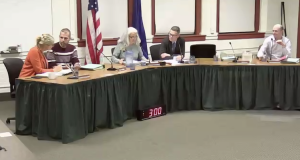
The Brattleboro Selectboard held a long regular meeting, learning about programs and opportunities with Interaction, hearing an update about BDCC/SeVEDS, and holding an extended conversation with state legislators about the Town’s legislative suggestions thought up by town staff.
Most interesting, beyond a hint that education taxes in Brattleboro could go way down, was talk of a new waterfront trail along the Connecticut River from the old Hinsdale bridge southward. Dreams of connecting this future trail to the West River Trail linger.







Preliminaries
They start… late.
Chair Elizabeth McLoughlin – I’m going to begin. Peter will come. There was one executive session at 5. This is our regular meeting. I’ve gotten some questions about us not collecting leaves this year. We’re saving about $20k to do it this way. It was a service we decided to cut. The Town has some good ways to take care of leaves and has created a video, which we’ll show now.
(shows 2-3 minute video about leaves; not very audible)
Great. I want everyone to know it exists. Don’t walk at night without a light because you can’t be seen.
Town Manager John Potter – Skating rink opens soon; rates online. Passes available. Parks staff have been prepping the facility for opening on Saturday. The 50th anniversary is coming up, with free cake and clowns. Free skating for those in clown costumes. Friends of Brooks Library are underwriting passes to cardholders. Gibson Aiken opened for afterschool activities. The halloween events are on Friday October 31. Parade at 6pm at Co-op to Gibson Aiken. Paving for this year is wrapping up, but some more needs to be done. parking restrictions remain in effect. There will be some daytime work, too. Most work is signage and minor finishing work. Human Service applications due tomorrow.
Oscar Heller – Amanda and I have been scheming about leaves. We plan a community leaf pickup with volunteers – picking up leaves and taking them to the district. If you want more detail contact me or Amanda.
Amanda Ellis-Thurber – the Brattleboro leaf brigade to help people with leaf removal. We’ll pickup on Sat Nov 1 in the morning. Volunteers will meet at the high school. We’ll do it two times, to help people who need leaves picked up.
Peter Case – On Nov 8th, we want the bike community to come out for Cranksgiving at First Congregational Church, to raise funds for food shelves. 8-12 am. My store’s website has details.
Amanda – I want to wish the Brattleboro stamp collectors a 90th anniversary. Also, Peter Amidon was a beloved member of the community, so condolences to his family.
Public
Terry – the leaf pickup – the issue was communication about it. We’ve been working on our yards for weeks and there was no notice, and the website had old dates and wrong dates. I’ve lived here a long time and have been impressed with the Town’s communication, but I hope people take this more seriously in the future. It would have been more helpful. Solid Waste says to rent a giant bin. There was no foresight, and it added to frustration. I wish communication had been sooner and more broad. And keep the web site updated. Be organized and keep in touch.
Liz – the website is up to date now and tell your neighbors.
Terry – I hope in the future… you’ve known for a while.
Liz – I’m sure there has been some of it and you missed it.
Oscar – point well taken. This is a community project and not a town thing we are doing. If there were mistakes, these things happen.
Steve – I made an observation. It was interesting that building policy for social issues involved in the 1700s, Brattleboro had a Poor House. In that day, communities tried to help people who needed help in their communities and didn’t take in others from elsewhere. Something to think about with policy. Some involve numbers of people coming here because of our policies. That was interesting. There’s more to it than that. 300 years ago they did things that made some sense.
Dick Degray – I had asked John if the human service director was getting a stupid and you said yes… could you give me that figure? Also, are we advertising for a finance director, and if not why not? We are paying the consultant 140k or more a year. Thirdly, at last weeks meeting, one board member talked of overtime with the fire department, and it wasn’t really pursued. I hope the Chiefs are here to discuss fire and police overtime. None of you talked about overtime being out of whack. You have a fiduciary responsibility to the taxpayers. None of you asked why we are 1/3 into the budget 2 months into the year. You have to ask uncomfortable questions. The last question is, today, midday, I saw all of our police cruisers driving at a high rate of speed coming down Putney Rd. I get concerned at high rates of speed. Was there a catastrophic incident going on? Lastly, a group I’ve been advocating for distributed 11k lbs of food.
Liz – the overtime of employees is of paramount importance to all on the selectboard. We are working every day to form the budget and reconcile those costs.
Potter – we had overtime for No Kings Day, emergency response like you refer to. WE have to think of fiscal responsibility, but also the high number of calls and safety. We have to balance it. The HR director gets $350 stiped per payroll to manage since dept money. We aren’t hiring a finance director at this time.
Terry – after I shared what I went though, yesterday I tried calling your office and no one called me back. Today I called and I’ve lived here 40 years. I’ve never bee treated with such disrespect.
Liz – we apologized to you.
Terry – I want it on record.
Randy – I don’t want to beat the overtime thing to death, but a good way – if you find towns of similar size, find out their number of calls.
Consent Agenda
A. Better Roads Grant – Approve Application
B. Announce Committee Vacancies
Consented!
Interaction Update
Liz – Interaction Update, so let me ask, Russell and…
Russell Bradbury Carlin and .. Kaci Viado, codirector of restorative justice.
Kaci – I will have a question for you at the end – we know you have been thinking about community safety – what are some of the concerns aren’t being addressed yet? My hope is we can think about how our programs might help. I’ll start broad and talk about Interaction, and some programs. Interaction was Youth Services in 1972, and court diversion has been a part for 40 years. We have over 9 programs total. Two other departments – behavior health and youth programming departments. Tonight we’ll talk about restorative justices. We rebranded to Interaction, and in restorative justice we work with all ages. WE have staff and volunteers, collaborating with government agencies. Recharge used to be know as justice alternatives – to address an offense without court involvement. It addresses the harm – the impact of the event, the harm created, reduce it happening again, making connections in the community, connecting victims to hear their needs. We hear from people affected by crime for people to make amends. Complete the program and charges are dismissed. It is a confidential program. Recharge requires retail theft, mischief, trespass, or a crime to get referred. Brattleboro Police send referrals our way. The incentive to participate helps those harmed, hold the responsible party accountable. Charges can be dismissed if completed, so it isn’t on a record. It has high accountability. If they don’t participate or fail, they go to court. Sometimes things aren’t a fun crime – community restorative practices to deal with issues that aren’t quite a crime – to create a foundation to talk through differences. We work with housing trusts to work with tenants and staff, we’ve trained community organizations. If people have a conflict, it is by self referral. Reach out and we can help you with a conflict. What do we do? It depends on the issue. Why do it? There are conflicts that cause discomfort but aren’t quite legal concerns. Resolve tension before it escalates.
Russell – I’ll be curious to hear any questions.
Kaci – Any questions, but what are some things you are seeing or hearing from community members that haven’t been addressed.
Russell – we’ve been discussing what we can bring to the town. One question we come back to, and many projects have already launched, is restorative justice could help and repair harm over time. What are you seeing or hearing happening now?
Liz – I’ll wait.
Isaac Evans-Frantz – calls for emergency services. Increased level of calls. What can we do to reduce the burden on emergency services in town.
Liz – they get a call, they go, and then they make referrals. Reducing the load is fine, but the initial call – that isn’t one of them.
Russell- One thing would be helpful would be getting upstream of the call. It doesn’t just happen. If we go there before the police got called, maybe we can reduce that. We aren’t equipped to take emergency calls.
Isaac – what are our concerns, or questions? There are a number of concerns about safety – violence, poverty, health care, housing, food assistance all in jeopardy at federal levels, drug trafficking… those are some of the concerns. The questions I have is where do you want greater partnership with the town? W are stretched, but want to know. Also would like to know about your volume of referrals and capacity.
Kaci – we increased capacity and increased referrals. I’d like to increase referrals from the Brattleboro Police Department. We need to get out there. Let’s be best friends with the police department.
Russell – From our thinking, knowing some facts about what is going on in town, we might more strategically make referrals and get ahead of some of the things in town. We need to have something “criminal” for the program, and not everything rises to that.
Kaci – say we are seeing more people sleeping on doorsteps – we could handle that. Meet with them,. talk with them, prevent it from continuing, talk to them about impacts to the community. If the selectboard hears about a crime on the rise, we could check in with the police, and they could send us that sort of referral.
Peter Case – I have hundreds of stories of what happens downtown. There has been criminal activity that is handled on the street level. I wanted child safety zones…. what is your thinking on these. It’s in the community conduct ordinance that was voted down. I still believe the need, and in harm reduction and restorative justice, but when we drill into child safety zones. With the substation it will mitigate a majority of what we see. Do you have plans and thoughts about revisiting that?
Kaci – my big concern was that we wanted to make more civil violations, and we can’t accept them as civil. Need to be criminal. I don’t want ti confined to specific zones. We can figure out what kinds of crimes should go to restorative justice.
Peter – so after they are arrested you can have a chance… but if we can predefined them and not get to the crime level, you could assist.
Kaci – as long as they aren’t civil…
Russell- my understand of child safety zones is headline-ish. I’d like to see how it has or hasn’t worked in other communities. maybe there’s something we can come back with.
Liz – it is also a matter of case numbers and paid by the case…
Kaci – not paid by the case, it is about the offense.. The officer at the time of an offense who wants to refer this still issues a citation, and a court day way out, we get the referral . We work to create a plan, and if it is successful it gets dismissed. If someone doesn’t show up and doesn’t so the program, or refuse to take accountability, then they go to court.
Oscar – interesting programs. We hit the high notes of problems, and we’ve been in One Brattleboro meetings. You do some housing for youth? A big topic of us is sober housing in the community. Come to the Town when you need help.
Amanda – what we’ve heard – concerns: accountability about drug trafficking, open illegal drug use on the streets, trash being left on streets by open illegal drug users – needles and other things three times a week. And, also, the importance of swift and certain consequences closer to the time of the event/crime. Does the referral happen with a judge?
Kaci – from the police department, and approval from the state’s attorney office. The three months allows us to create the plans and complete the plan. Within 90 days we hope to address everything. Closer to the offense is important, and covid created long backlogs.
Russell – how soon after the police officer issues a citation?
Kaci – 3 days.
Amanda – how “old” are the state’s attorney offie referrals..
Kaci – a couple months?
Amanda – how is the person taken care of that has been referred – how do you not lose them?
Kaci – people call us, and we stay engaged by collaborating with Groundworks, or other services and support people, make it accessible and quick as possible. We get them scheduled and connected quickly.
Amanda – are there consequences for attendance?
Kaci – things happen, so it is about taking accountability – are you calling and letting us know? What do you need to get to us? If they keep missing appointments, back to the court process.
Amanda – what percentage completes the program?
Kaci – 60-70%
Amanda – a need. There was a daywork program that you had and in our selectboard retreat we talked about getting it back again. MY farm donates a lot of food, and woodworks say their customers want something to do. Any way to get people working would be great.
Russell – there was funding through the town for that. If we could find enough money we could put something together. It was a great program.
Liz – a couple questions. I’m hearing from the community that ultimately you hope to make better tenants and shelter residents?
Kaci – that’s not quit e the goal. We want a community that can talk about differences. Tenants and landlords often have conflicts.
Liz – the police department can’t refer people but they know, so without an official referral, you could go around to people in town on stoops… that doesn’t happen?
Kaci – street outreach? Not at the moment.
Russell – something we are considering.
Liz – One Brattleboro has outreach maybe they could give referrals. That could lead to child safety zones. Safety and needle cleanup. There is a lot in there. I appreciate you collaborating with us.
Dick – How many bites at the apple do you get for restorative justice? How many times can you get referred? Also, I went through this with someone who did damage to the flowers and I was a partner through the process. How long does it take to adjudicate the people sent to you? And also, Amanda – we gave $65k for that day work program, there were a lot of issues with it. Issues on Youth Services side for signing up, etc.
Kaci – Someone can be referred more than once – maybe some time has passed. The recharge program is pre-adjudication. That’s meant for quick responses within 3 months. We have programs post adjudication that take much longer. maybe somebody at the time of offense is not ready for precharge. We have other court services along the way with more stringent conditions.
BDCC/SeVEDS Update
Adam Grinold
Laura Siberia
Jen Stromsten
Adam – we need to build capacity, too, and have over time. With helping businesses, getting grants, and partnering with others. We’ve stepped in to own Tri-Park to give confidence to state investors. Partnerships over time – Rural economic development. We continue to build that capacity. Tonight, we have an annual; SeVEDS funding request. You’ve heard from us in the past.
Laura – just reminding you that in 2012 we started fundraising with you. Our CEDS 5 year plan showed us we had a workforce challenge, and the programs we’ve built. We came to you and we all worked on the closing of VY. You challenged us to talk to all communities, and that helped us. Trying to increase capacity of region to solve problems. This year, we sent out a survey and are interested… we think we are responsive but this could help us assure ourselves, or we can adjust.
Jen – the annual report is a look back. It is organized around 4 buckets. Our new web site also has 4 buckets. It captures the breadth of what we do. One of the best ways to understand what we are up to is to look at our site. We have events listed there. We offer classes. We look around at what is out there. We look at what others are doing, then see if there are gaps for us to help within our mission. Digital literacy for job seekers – word processing and other skills. We work with partners to help with resources to start or grow a business, and connecting people with resources. We have high school programs, help people get hired, helped kids interested in careers in trucking. We want to connect everybody.
Liz – thank you. In general, the broad is very focused on economic development, and are eager to work with you on it.
Amanda – I appreciate your engagement with the trades. Keep it up. And trade business ownership. The contractor owners are aging. Reach out the selectboard members – we are well networked. We want to help catch those businesses entered here. Include us in it. Don’t feel alone. And how to we stay informed about the bigger businesses.
Jen – people think we try to get business to come here… it is mostly cultivating businesses that are already here. A lot of it is business succession. When a business goes away, it is hard to restart.
Adam – we understand the potential and spaces, the existing businesses and clusters. The vast majority of economic development is helping locals. Sometime they grown and get acquired from outside and leave the state. We hear a need for regional marketing. Some communities are doing amazing things with no staff but good strategic plans.
Oscar – Glad we make this investment. Please reach out to us, we are here to help. This funding should be from the reeling loan fund.
Liz – terrible idea.
Adam – the larger projects? Often they are confidential in development. NDAS get signed. Not always. We might have a significant project coming.
Peter – I know the good work you do. Wherever we can help let us know.
Isaac – Thanks – I’ve volunteered and have seen what you have done. I appreciate what you do.
Liz – I’ve seen your work widen and get more drilled down into individual entrepenuers – the Hatch Space etc. You are tenacious…
Isaac – this comes from the general fund? Oscar?
Oscar – not recommending a change this year. If are to spend it every year from a fund to replenish itself seems unsustainable but no changes needed for this year.
Isaac – this is recurring and we do it in the past. We don’t want to use one time funds for ongoing expenses. One priority is fiscal discipline. Why delay it, Oscar?
Oscar – if we change it now, it would come out of unallocated funds? We can talk about it for the next budget. We can do it this way this year.
Liz – and I’d refer the taxpayers not pay for this. The general fund comes from taxes, and the revolving loan fund is money received from loan paybacks. It’s there to be used for economic development. It’s a bonanza fide use for those funds.
Peter – I agree with Liz on how we spend the money and not put it on taxpayers. We don’t want to talk about cutting this back.
Oscar – I agree with Isaac, but not at this time. It’s not financially sustainable as is.
Amanda – this conversation is evidence of scarcity, and the scarcity mindset we have, and the belief in BDCC to help us. We need to diversify our economic revenue.
Heidi – Are you doing any programs or outreach to new immigrants and refugees?
Jen – we’ve been working with that community to establish the program, and provide employment when they arrive, then workforce development. We have been referring people to different providers to start businesses. We have mainstreamed some folks into some programming. Part of it is gaining the language skills. It is ongoing. Maybe 10-12 new American businesses right now?
Dick – a brief history – it was $50k and RTM voted on it. After I got off the board and RTM, this became more contentious. Then I got back on the board and the amount was reduced to what you get today. It would be god to have the discussion of where to take the funds to pay for this. BDCC doesn’t recruit businesses, but they help them once they are here.
Randy – I agree economic development is important. Remember last year – we want a reasonable budget and low taxes. be careful about raising taxes. What will we cut to pay for it?
$36,147 to SeVEDS for FY27 – passes 4-0-1 abstain
Liz – we’ll adjust the agenda. Planning Staff can do town owned meeting at another meeting. To fit in the legislative delegation. We’ll take a five minute break.
CT River Pathway Project
Liz – let’s re-convene. I see we have the pathway, and we have Sue Fiilion and Alex and Jason.
Sue Fillion – Alex Wilson and Jason Cooper had a project, from Friends of the West River Trail.
Alex – thanks for letting us talk about this. I’ve been a Friend of the Trail since 1997. It’s been a great 25 year effort. All volunteer effort, we’ve acquired parcels. When we first began, the first major donation was from VT National Bank. To attract employees to the bank, they thought the trail would be good addition to town. We have tried to connect the trail to the downtown. We tried to get the railroad to let us use some land and that hasn’t gotten anywhere. Also want to create a trail south of town to the FT Hill RR bridge. That’s the piece tonight. This would open up the opportunity to connect with 80 miles of rail trails in NH, and an incentive to fix up the RR bridge, 1/4 mile in length. It would be a real attraction for recreational trail users. When Brattleboro acquired the strip of land 10-15 years ago, it opened up that opportunity. The challenge has been Barrows Oil – from their parking lot by the Amtrak station to this strip of land. They didn’t have interest in that. When it was sold this year to Roberts Energy, we reached out again and we walked the property. They were receptive to the idea. We started talking about an easement – they’d provide an legal easement that could revert, but as long as the fencing and trail design was paid for… once we get to town owned land it will be really easy, with volunteer labor. We’ll need some surfacing material for a good bike surface. We have a memo of understanding in place. It’s a framework for developing the easement. There are some costs. We are designing what the trail would look like. We’r seeking the right of way to put it on town land at the north end of the Roberts Energy property, but also the strip south of Roberts Energy. The intent is to create the trail at no cost to the Town of Brattleboro. We’ll look for in-kind support for permits and letters of support, and help connecting to other parts of the trains station area and bridge, and hope the town will give us the steel left on the property. It has some value and we hope we can defray some of the costs of building the trail. That’s basically what we are looking for. Finally, it is separate from the Hinsdale Bridge, but this would start at the Brattleboro end of the old Hinsdale bridge. This new pathway and the Ft Hill bridge decked over can serve Brattleboro and Hinsdale. Could help justify maintaining the old bridges.
Jason – when we first started it was a long run, trash, homeless encampments. All volunteer effort to clean it up, and then the public began using the trail. The problems didn’t;t come back. Hundreds of people a day on tat trail. We have one right of downtown, for a lunchtime break. It is an additional amenity. The hope is when that happens, we can connect Bridge St to the West River trail, and then if the Island falls into place.. a huge asset to the town.
Sue – this does compliment the town plan very specifically. We have long talked about making this connection. We’ve talked with Hinsdale. There is some real possibility.
Liz – a wonderful plan. Thanks!
Amanda – very exciting – regarding stewardship of invasive plants and who deals with it? And what’s the width of the trail?
Jason – 8 feet wide the whole way.
Alex – invasive plants – we worked with the state of VT conservation board and NRCS to help with initial control. Since then, we rely on volunteers to pull up sprouting bittersweet and honeysuckle coming back from the seed bed. We are very conscious of invasive plants and would do similar practices. We’re calling this the CT River Pathway. It’s not part of the West River Trail technically, but we are taking it on.
Oscar – sounds great lets do it.
Isaac – the river is such a valuable resource. I can image people being able to take a walk there…
Peter – it takes work to build a trail. I don’t recall the effort that went in to the West River Trail. What the timeline?
Alex – we don’t know what permits we need. ANR? State of NH? We just don’t know yet. Peter Van Ot is helping us out with environmental permitting. Ideally we get through permits this winter, do our design, and start working next spring. That’s probably optimist.\ic.
Liz – I see great synergy with the West River Trail, and museum. It would be wonderful and I thank you for taking it on.
Ian Goodnow – thanks for the work. I am a young professional that moved to Brattleboro and love the trail. This is really exciting. This is jewel the town can invest in. The entrance is really important. If it is on town property, maybe designed with the Amtrak work? If the town can do anything with signage or how it interacts, the more the better.
Jason – we’ll pass the Roberts property, go along the river, and the entry is at Bridge Street right beside Anna Marsh bridge.
Liz – we will lend the expertise of our Town Planner as we proceed.
— this motion does not address the portion discussed… just to the Roberts property, not to the bridge.
Sue – the park and parking lot need more design there. We’ll come back for that.
Easement for tax parcel 00330004.00… 5-0 passes.
Town-Owned Properties is postponed… so…
Review Legislative Priorities
Liz – we’ll table the town owned property update to a future meeting.
5-0
Liz – we move to asking our Brattleboro legislative delegation to join us at the table. This is a rare and wonderful opportunity.
Ian Goodnow, Emilie Kornheiser, Molie Burke, Wendy Harrison
Emilie – I want to lay groundwork for the upcoming session. Last time we were here we discussed the balance of power has shifted. When committees start in January, they will pick up where they left off last year. We have a majority of house and senate democrats but not enough to override a veto. Things can end up in gridlock, or great collaboration happens for everyone. Some of the work Brattleboro calls on us, it isn’t possible right now. The other thing, the fiscal environment – the state of the economy with tariffs, uncertainty – we are expecting much lower state revenues, not keeping pace with inflation. We are seeing the end of COVID era spending and the extra revenue from interstate from that is gone. We’re adding HR1 at federal level – medicaid changes, food assistance changes… that will lead to a loss in state dollars for the federal programs and more administrative costs, and a lot of scarcity. people will be kicked of of Medicaid rolls, there will be a loss of dollars to community partners and the state as a whole. There is fiscal uncertainty and scarcity. Tighter year than we’ve seen in a while.
Liz – also a lean year at the Town level. We are hoping we can find opportunities to fund things in town and things that would might be available. The more we have opportunity to tell you about our issues, the better. John, what to start?
Potter – the board met in August and you identified 5 priorities. This year, we organized around those five priorities – increase revenues – increase municipal share of the local option share tax from 75 to 85%, That could be really helpful to the budget. Another idea – to give towns authority to towns to put a local tax on fuels, and a mother would be to limit the number of properties being tax exempt. All those were to increase revenues. I’ll pause there.
Emilie – it took a lot of work to raise the LOST. It was tenuous that it happened at all. Can’t reopen it again until we know the fund has money. We changed it as much as we can. We can be looking at PILOT funds. Tax exempt properties would be funds paid by state government for state owned properties. Brattleboro doesn’t have a lot of those, but we can take a look ta how PILOT funds are used for judiciary properties and county properties. We’ll help with that. As for numbers and types to tax exempt – there were changes to federal law, so we will need to firm up our definitions. We can look at the properties exempted. The town votes to expect properties – good luck to you. One the fuel tax… Mollie.
Mollie Burke- I agreed to request bill and I have, and it is being written up. I assume it would ge assigned to my committee. I’ll keep you posted. The town can advocate for that as well once it is active.
Oscar – we talked about this at our pre-meeting. Like other LOST are held back, the fuel tax could be the same. Like the others.
Liz – or at a higher percentage.
Emilie – the more you can come with other towns, the better. The LOST is collected by the tax department., Fuel tax is connected by the transportation dept. They’ll need a whole new system. They’ll need revenue to make it happen.
Liz – is there something the state can do to, we have a tremendous number of non-profits – something to offset the non[profit properties in our town.
Emilie – her states do it with revenue sharing agreements.
Wendy Harrison – properties that are tax exempt vs properties owned by non-profits are two different things. Stormwater Utilities – we are getting close to making this happen. It wouldn’t just substitute a new revenue source but properties that are nontaxable now. In most towns, half of your public works budget is storm water costs. It’s a big part of the budget. I got some language in Act 37 for funding for new stormwater utilities. 2027. IT’s be good if the town supports that effort.
Liz – I’ve wanted it for years.
Mollie – every year the town highway aid fund has an inflator in there. We did that with roadway and structures grants. We want to help our town.
Emilie – the state transportation fund hasn’;t had enough money for years. We had a midyear revision. People were laid off and programs were cancelled, but town highway funds were maintained. last year was hard enough, and it feels like everything is getting harder, and we are doing our best to look out for Brattleboro.
Potter – the second one is state revenue sharing and helping hub communities, finding ways to rebalance resources across the state – sharing state revenues, a state grant fund for waste collection of some things.
Emilie – two years ago we did a lot of work to share state revenues as you described. We outlined it, got a report, worked with the treasurer, looked at best practices, and the report was shared with you last year. You need to work with other hub towns to build political capital around these issues. Great idea dns solid mechanisms to make it happen. On the topic of grants for collecting syringes and encampments, we’d like to look to existing funds for allowable uses, or expanding allowable uses. Maybe the opioid funds. For abandoned vehicles…
Wendy – I’m working on solid waste, and thinking of abandoned vehicles. I’m interested in that.
Potter – there was an abandoned RV that the town removed from a state land right of way. Quite expensive and we could use help with that.
Amanda – a shout out to the town manager for networking with other hub towns. It’s ongoing. Lots of the public doesn’t know that. He’s very engaged.
Potter – legislators from hub towns should get together.
Liz – I’m collecting information from other towns, to standardize our need to other hub towns.
Emilie – maybe the state GIS could get involved.
Oscar – we like your feedback
Isaac – I like the framing and your responsiveness. I want to clarify that as we go through these, we discussed the priorities but not the recommendations. We’ve never discussed these points. They are recommendations from the d=staff.
Emilie – Oh.. thanks.
Potter – just thoughts and concepts…not recommendations.
Liz – our next priory is
Potter – child safety zones – safe welcoming spaces for children and families. Some concepts for consideration – increasing drug addiction treatments to residents, and court ordered treatment pathways for certain individuals.
Oscar – if you’d be willing to say a few words about a backlog and lack of funding in the justice department.
Emile – we put more funding toward the judiciary to manger the backlog but it takes time.
Nadir Hashim- increasing drug addiction treatment we hear about it all the time. The uncomng year will be challenging. We allocated more money last year to treatment centers and enforcement. WE want DOC to work more with services in the community, for people who have been sentenced, or people on their way out of jail. There are challenges due to logistics right now. Act 16, opioid abatement fund. What this does – three parts are annual appropriations. For recovery residences, it helps them stay solvent. It will occur annually. There is $12 million left in the fund and more could come in as the bankruptcy for Sackler resolves. Also money to HCRS for work in this area.
Emilie – last year, thanks to conversation with you, what folks considered the end point of funded treatment, it was easy to get an extension. That’s been paying off dividends. Court ordered treatment…
Ian – I’m the newest member of the delegation. Nadir is on Senate Judiciary, I’m on the House judiciary. Drug addiction and mental health overlap, and in judiciary we struggle to help people with massive issues. How do we effectively rehabilitate someone, and how are victims served by the system. Precharge services for drug addiction, then asking what is the next step after that, including some time of rehab, or ordered by the court, which could be involuntary, and that might be something we are talking about. Big ideas and lots of conversations coming. That’s what we can do with drug addiction – recharge, then a ladder of more stronger potential ways the state can intercede and help. Someone suffering from addition will have 100 records. The other half is mental health issues. The idea is competency. if someone is incompetent – what do we do with them? It’s a huge issue for the judiciary. We’ll begin looking at it. These are the two things. People are falling through these gaps in the judicial system, causing chaos in the community. Involuntary anything is an important thing we take carefully and talk about in an informed way. I’ll let Nadir respond. What is the other thing? Diversion 0 we need to figure out transport.
Liz – very frustrating.
Ian – Windham Co just got another prosecutor to help deal with the backlog. These things are delayed. Need more judges, prosecutors… then wait to see if it worked.
Liz – drug court transportation is very frustrating.
Nadir – I thought I could accomplish it in 2 years, and it has been 5 years… we’re 90% there. We do have a meeting with the Chief Superior Judge to come down and I’ll ask about having a drug court down here. Court-ordered treatment – we do have a mechanism – they need to refuse voluntary treatment, then there are other steps, that can then force someone to be treated. One change I want to make is the range of people who can make that determination – broaden to psychologists and psychiatrists can evaluate. Same with court ordered treatment – it is only psychiatrists can evaluate now. The backlog – we need more lawyers, both prosecutors and defenders. The Defender General said the short term outlook is good, but the long terms outlook does not look good. There are updates to the speedy trial laws needed. I’ve learned a lot over the years. I have somewhat of a solution to introduce this year.
Liz – we’ll join you in any big discussions you want to have.
Ian – one of my reflections is how powerful individuals testifying in committee can be. We want to make sure we bring you up when we have issues at committees, or people who want to speak on something,
Liz – careful what you wish for…
Emilie – many were really trusted for redistricting discussions.
Amanda – funding for state police and state drug task force?
Nadir – there is a very useful web report that is searchable and you can look for numbers and sections for whatever you are searching for.
Amanda – I’m all for treatment and helping people, but the influx of drugs and active drug trafficking… we are a gateway to the state. I’d like legislation and fund for the state police and drug task force, and putting resources to it.
Emilie – one reason I talk so much is I’m chair of the joint fiscal committee – we ahem a real internal debate about policing – depend on the state police to do the policing, sheriffs? police departments? In Brattleboro we think of the state police as extra bonus police, but in some places it is their police. It seems essential to focus on drug enforcement, but state police are caught up ion doing regular policing in many towns. That’s why it is hard. Federal money has always been the clearest source of funding, but that has shifted.
Amanda – our three exits off 91 are opportunities for business, and for drugs. The I-91 corridor is struggling with homicides and bad stuff. It’s not as simple as that… It’s some creative solution beyond state police – a combination of things. We have been helped by the drug task force to bust some drug houses and there is more to do.
Liz – when Jeanette White explained to me what towns do for policing, it wa saw dropping and shocking. We’re a real town and have real police.
Emilies – other towns are real towns. They don’t have professional unionized police forces.
Liz – catch as catch can. For us it is a major part of our budget. We need a professional unionized police force. I’m grateful we have it. It’s a force for good in our town. Anyone else?
Wendy – how you looked at this as child safety zones – they need to include social media and the internet. Homicides and happening to children. Inform yourselves. If you have children – they should not be on social media without observation. Serious harms are happening. We have a solid bill to address it.
Liz – housing?
Potter – Housing was big priority and a couple ideas – level of subsidy for housing has been great and developing infrastructure support programs. Additional funds for sober housing units. Interest for clarifying legal authority for property mangers to remove non-tenants. And supporting the establishment of regional landlord tenant courts for housing disputes.
Wendy – we had the Home Act and changing Act 250, and the town is becoming tier 1-A. It is important towns have the authority to enact ACT250 like things, but should be the enforcer of previous Act 250 permits. In the last couple of years we’ve focused on traditional affordable housing and private sector housing. The CHIP programs a combination of public and private. What would be helpful would be you could more easily finance infrastructure. CHIP will help. In 2024 there were more housing permitted in Brattleboro since 1989. Same trajectory this town. Housing is getting developed at a very high level.
Liz – it is not enough
Wendy – but it is a lot. What we have done has improved things so we are on the right trajectory. We don’t want to do this lightly and make huge mistakes.
Emilie – we also did the home share program – ways to help make roommate connection – Windham County has the second highest rates. We’d appreciate if the town reads the CHIP rules and gives us feedback so it works for you. And also the sober housing – there is significant funding for that with an eye toward Brattleboro, and community partners have not been able to put it all together and spend it. There needs to be an immunity partner ready to spend it. I;’m happy with how much shelter housing is coming together here. And for the housing committee is planning on taking on landlord tenant laws this year. Everyone agrees it isn’t working.
Liz – there are landlords and tenants who would be great testifiers.
Peter – why these issues, with a bad tenant – why it takes so long to move them out of a building. Maybe there is drug dealing going on. What is the hangup?
Ian – it is probably two issues – one it is someone’s home – the tenant – so when we allow someone to take away something essential, there have to be protections so it can’t be abused. And VT is a cold state, so we have an incentive to minimize winter eviction in our laws. There are lots of views and discussion. It’s an essential human right for the landlord – property – and the tenant – their home.
Amanda – can you priortize obvious egregious stuff? Where someone has been raided, or someone has died there… an evidence-filled situation could be prioritized?
Emilie – even in an evidence filled situation has nuances. maybe that person living there did not voluntarily allow it to happen. Maybe there are a victim?
Ian – so, I think, so… it is a very…you gotta love a narrow issue… the reason I bring it up, there is a=some tricky case law around this issue. You have a non-tenet in a property, if they are using chaos, how can they be no-trespassed without big hoops. There is tricky case law around it that I won’t bring up, but despite that, I hope for a bigger conversation about eviction law. Others agree with you general idea. It could go nowhere, but what comes from it might be a conversation, so what I’m really getting at it that it is all intertwined and launching this rocket will get the conversation going and yes, I know the board didn’t vote on these bullet points but people are talking about it.
Isaac – it is critical for tenants – I’ve heard horror stories.
Ian – a lot of the work for these things happen before e the session starts. Point 3 – establish regional landlord tenant courts. I just want to remind Liz, back when I was on the board, when we got rid of first month and last month rents, and what we learned was the statute says the municipality could establish a landlord tenant… thing. We had a conversation about it. I’d encourage you to look at that statute to see if that will satisfy it.
Liz – Yes it will. Is there funding for it? Would the public like to speak here?
Dick – going back to bullet 1 and revenue – over 10 years ago I ripped a gas tax – a state tax. It needs to go up. We aren’t getting tourists to pay enough. You say it is a regressive tax – you just raised the bottle deposit. That impacts low income people, but I digress. If you implement a 10 cent gas tax – state, local, and a fund for towns without gas stations. It is hard for towns to generate revenue. Can we raise rooms and meals to 2% We should have that option. Another way to generate revenue from tourists. I’m really strong on the gas tax across the state. There is a huge impact in roads from tourists. And overweight trucks should get an increased fee.
Emilie – municipality cannot go up to 2%. We raised the overweight vehicle rate two years ago. I have mixed feelings about the tax rate. Call the governor to discuss it, cuz he won’t allow it.
Nadir – the most tumultuous discussion ever in the legislature to bring up the gas tax, regardless of the merits.
Mollie – I was on the committee in 2013 when we brought up the gas tax. We are in the process of implementing a mileage based user fee for electric vehicles at first, so they pay their fair share for the road use. They pay more for registration.
Liz – gas tax vs adding to the gas tax?
Emilie – politically, a local option tax is more palatable politically, so historically the governor will sign to those, but cost more to administer so…
Randy – when we talk about who would control the gas tax – is there any way to just partner with the tax agency and have them collect it? Rather than start from scratch? People don’t know how long things take. On the crime issue, it is hard. If there was some way for repeat offenders – 30 times – we need to relook at it. Every time a police officer pulls someone over, the statistics go up for injuries. We’re trying all sort of things, but if we could solve that it would save money and lives.
Nadir – point well taken. It’s an issue we hear about every year. When it comes to someone being held prior to being convicted – a violent felony, or a life sentence punishment type of crime. These are right in the VT and US constitution. There is bail for risk of flight. It is a difficult issue to navigate. If someone assaults someone then goes back and does another crime the next day, that might not get you detained. It isn’t a felony. There are a million hypotheticals to discuss. The detainee population is at a record high in our state. We are detaining more people and it… I’ll leave either it there.
Ian – we are talking about people’s liberty, to speak to the issue you brought up, the legislature looked at bail revocation, where they should no longer have the right to bail. It exists in state law, so the legislature took up the issue and didn’t figure out a solution. We are working on, there is a lot of energy behind it, and trying to find a way to slice this pie to not overstep their right to bail but preventing the real issue in the state.
Randy – if local things rise to the level of it being a new crime. It’s like if you have trespass or shoplifting… they are all minor but if you get to 30 of them.. it is similar people who keep doing it. Can they move to the front of the line.
Emilie – we do that a bit, with shoplifting…
Christine – my staff and I have done situation table training. I want to speak to that whole group – since I’ve worked at Brattleboro Housing. I’ve seen some radical collaboration . I’ve never seen this kind of collaboration before. We are going ground daily. One thing I struggle with the trespass. We have gained lots of tools, but it is really challenging for getting people out of a property who is causing trouble. I don’t want to take rights away, but residents are asking for more help and my tools are limited. How can we do the radical collaboration more…Amanda is right – it takes a long time. It is complicated to get people out of a house…an eviction. People will move from tenant to tenant stacking victims as they go. We need a tool to help with that.
Marta – I wanted to bring up in addition to landlords – we have a large percentage of renters. It seems hard to remove tenants. It is also true that any renter can get a 60-90 day notice to move for no reason, who have done nothing. The average renter lives paycheck to paycheck and has no means to move, and there are affordable rentals. 30- 60 applications for a single apartment. Rents have gone up 50% with a 60 day notice, and it is legal. In this case, keeping people in existing housing is way cheaper than having families and other camping in the rough or living in cars. Urgent moves are common. I hope our reps work on this – make it harder to remove someone who is paying their rent and following the rules. People live I cars and go to work because housing isn’t available.
Emilie – landlord tenant law might shift – we are at a crisis point for tenants and for landlords, so I think a legislative compromise to make inroads might look like… in certain case, the ability to evict gets faster, but in other cases other rights are given to tents to make it happen. When we go through the session, if you want to get involved, step in and try to get part of what you want to get a bit of this other thing.
(They used to take breaks for the ASL folks… ahem)
Oscar – the political path probably requires a compromise – it makes sense.
Elizabeth – WWHT Director – in looking at housing priorities – there is synergy among the items. Windham County has among the highest levels of emergency room visits for opioids, but there aren’t sober housing options here in Brattleboro. ONE Brattleboro is working on this. Christine said good things about no trespassing. People are not living in a sober environment and don’t have control over what is in their hallways. Speeding up the process for some disruptive behavior – I think that’s the right approach to balance rights and things we need to accomplish.
Susan – I’m a private landlord and manage 20 units. WWHT and the Housing Authority don’t allow no cause evictions. They have the resources to bring a case to court. private landlords don’t have those resources. If we have someone destroying a building, we don’t have resources to wait it out. We need to get control to make the building safe for the others in the building. When I call the health officer, they have no authority to remove the person. We need tools to keep our buildings safe and to remove the people who are not letting others live in peaceful space.
Liz – let’s…
Isaac – I suggested housing being a priority – someone recently told me rents were so high they might just not buy as much food this month. I’m interested in what we can do to make it easier to live in this town.
Emilie – investments in housing are a good first step. CHIP supports towns to build infrastructure to help development. Section 8 vouchers are being reduced, but more tax credits toward affordable housing developments. maybe it is time for a new housing bond. We are continuing to focus on affordable housing. It is not enough. It’s one of the most important things we can do. A top priority. We live here and it is terrible. It’s hard to make it work.
Elizabeth – one thing the general public may not know is that the WWHT changed its process for applicants. There is no waitlist now. We have a notification list now. First come first serve when a vacancy opens up. We send a list every Friday. homemakers.org will get you signed up to get the list.
Potter – last priority was financial responsibility and help. The skyrocketing costs of the town to get under control. Unfunded mandates, streamlining processes, and aligning fiscal responsibilities. We spend a lot of enforcing health orders… if we could us the threat of condemnation it could speed it up. General assistance emergency housing- it would be great if participation could be relative the size of population of Brattleboro, screening participants before issuing a voucher. 30% coming are from another state. It’s expensive for the town. Half a million on emergency response to these properties. We also don’t get rooms and meals from the vouchers, and subsidize us for costs for public safety responses. Unfunded mandates… and if there is some way to de-link education taxes from education taxes.
Emilie – the first point should be moved up to tenant and landlord law. Sue Graff should come to the selectboard to talk of the hotel motel eligibility – it is very narrow at this point. As for the cost…
Ian – the costs are real and the data is compelling. It informed our discussions last session. We want to ensure whatever comes out regarding hotel vouchers – that direct funds to Brattleboro – that those elements need to be part of that solution. It might be a separate bill from us, or with help from other communities, or from real advocacy in that committee. I don’t know what the advocacy will look like, but I hear the community and we are committed to making that heard in Montpelier and look forward to talking to you about that and I’ll really lean on you to get up there and talk about it.
Liz – gee, thanks. Just an idea about screening for vouchers. We have no screening.
Emilie – that’s not tru anymore. That’s why Sue needs to come. I met someone yesterday running a case management program. Sue should have the conversation with you.
Potter – we had someone luring children into a motel room with payday and we can’t check for sex-offenders. It would help with our public safety response. If the state screens, we are left with our resources, it would be so much easier.
Emilie – the program is limited to those with sever disabilities and people with young children.
Liz – the administration says they will work with us, but tells us to talk to you…
Emilie – the administration makes these decisions now. Shifting education taxes away from municipal property taxes – we spent the bulk of legislative energy working on education reform. We want to increase quality, but in Brattleboro ht homestead taxes should be in half for the next five years. It is intricate and pieces need to work together, but should result in massive savings for homestead taxes… the taxes that residents pay for education taxes on homestead will be reduced – primary residences and 2 acres or less.
Oscar – I want to acknowledge that I’m glad we talked about all of this. This priority was about internal controls and funds. That is what this priority is. There isn’t much fr them to talk about under this priority.
Emilie – we are in a federal shutdown. LIHEAP and food stamps are likely frozen. The legislature is working to release the funding on schedule for LiHEAP. Food stamps are also likely to be a problem on the 1st.The solution is not as clear. Many are really nervous. We are working to find ways for people to afford food. We have legislator conversations – individuals and group ones coming up at the Library.
Ian – we’ll do 1st Saturday meeting while we are in session.
Emilie – get in touch any time, anyone.
Amanda – thanks for the monthly information sessions.
Ian – 60 people at them on a Saturday morning.
Liz – thanks.
Motion to adjourn – 10:34 pm.