Recently, I stumbled upon some inadvertent endorsements for a Town Meeting style of governance I thought I would share. These are excerpts from several podcasts: The first is entitled “I Drove To The Worst Place In Vermont. This Is What I Saw” (Spoiler alert: it’s not that bad) https://bit.ly/4nzDwEn
In this clip, a question is raised about the values unique to Vermont. While acknowledging the rise in polarization in the country generally, the podcaster zeroes in on “old school Vermont,” where everyone at Town Meeting argues with each other, but then has lunch and talks about what unites them.
In the Coffee Klatch podcast, “Guns, Division, and Violence in America” with Robert Reich and Heather Lofthouse https://bit.ly/4poDvVc the point is made that democracy is not only about voting; it also requires thought. That is why deliberation is so important. Simply pushing “yes” or “no” on your iPhone is not democracy. Democracy requires us to understand the issues and change our positions if there are good arguments on the other side.
In a clip of an Obama Foundation video, “How to stop authoritarianism across the globe: a conversation with President Obama,” https://bit.ly/4mTHjeJ (at about 16:02) Zuzanna Rudzinska-Bluszcz of Poland notes that for some time we limited democracy to voting but democracy is something to be practiced, people need to be engaged and empowered. What we need is an active citizenry.
After a review of these clips. I would wager the reader might now agree that deliberation is a piece of our Town decision making we do not want to lose. As Frank Bryan and John McClaughry argue in The Vermont Papers (Chelsea Green Pub Co: Post Mills VT, 1989) p, 54
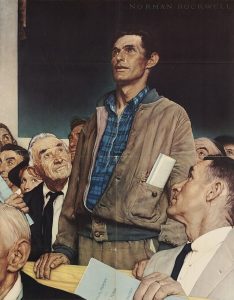
Town meeting government asserts the fundamental wisdom of the common person,sanctifies openness, abhors secrecy, holds the human spirit in the highest esteem, and is grounded in a fundamental trust that the truth will out in any free debate of citizens assembled. Town meetings must have been in the mind of E.B. White when he conceived his classic definition of democracy: “the recurrent suspicion that more than half the people are right more than half of the time.”
That leaves us then with two choices: Open Town. Meeting (OTM) or Representative Town Meeting (RTM).
Currently we have RTM, How did we get here? One factor was the size of the town. Our population hovers around 12,000, too small to be considered a city and a bit too big to be grouped with the small towns.
Then, there is this from an article, “Representative Town Meeting in Brattleboro – Part 1: Its Origins and Adoption,” March 10, 2014 by Chris Grotke:
Former Town Manager Corwin “Corky” Elwell was quoted in a 1989 Vermont Life article “The Brattleboro Way – Is This The Future of Town Meeting?” as saying “At times it got pretty unruly. It really was a case of who could pack the meeting…” and “It was pretty easy for the proponents of an issue to get their troops there and approve whatever was needed. Of course, there was nothing illegal about it. It’s just not a very stable way to carry on a local government.”
The author of the story, Fred Stetson, wrote at the time that Brattleboro was “seeking stability and an escape from Town Meeting Day shenanigans.”
A clear advantage of RTM is that it is indeed representative, in the way explained on the Brattleboro Town website: “The total number of town meeting representatives is based on the number of registered voters per district.”
That being said, what needs to be changed? Proponents of OTM believe the more open format will allow more voices to be heard. As a chair of one of the three districts, part of my job every year is to fill vacancies. And we usually have openings. Last year was more competitive than usual and allowed candidates to voice their reasons for serving. In addition, district meetings, held voluntarily during the year, allow residents to learn the process and become informed. This is the goal: working towards an informed, engaged and representative electorate to make the decisions at Town Meeting.
The essence of informed deliberation is served by RTM, as members have a stake in running for office, gathering signatures on petitions, talking to neighbors and studying the issues before the meeting.
Let’s work to improve what we have; keep the strengths and address the weaknesses.